Stainless Steel Grease Filters for Commercial Kitchen Exhaust Hoods
Source mesh-type grease filters in aluminum, 430, and 304 stainless steel. Compare mesh constructions, open area, frame styles, and stock sizes, and check NFPA 96 compliance paths before you send an RFQ.
View SpecificationsGrease Filter Specifications
A mesh grease filter is defined by six variables: weave structure, mesh count, wire material, layer construction, frame style, and size. State all six in the RFQ so the aperture, open area, and fit match your hood slot without re-quotes.
Plain and twill woven wire cloth, single-layer or double-layer sandwich constructions for grease filter media
Typically 14-40 mesh per layer with 40-70% open area depending on wire diameter; finer mesh traps more grease but raises pressure drop
Aluminum, 430 stainless steel, and 304 stainless steel as standard grease filter routes; 316 on request for aggressive washdown environments
Stainless or aluminum angle frames, riveted or welded, with pull handles and optional gasket edges for drop-in hood slots
Common stock sizes in imperial inches plus custom cassettes, cut discs, and framed panels to drawing for hood OEMs
Woven wire cloth per ASTM E2016 and ISO 9044; grease filter integration per NFPA 96 when part of a listed hood assembly
Select one or more specifications. Your choices will be included in the quote request.
0 specs selected
| Grease filter type | Construction | Grease capture method | Typical application and compliance note | |
|---|---|---|---|---|
| Mesh cassette filter | One or two layers of woven wire mesh tensioned in a metal frame | Intercepts and holds grease droplets on the wire surface and between layers | Light to medium cooking loads and OEM hood assemblies. A mesh element is a component: NFPA 96 compliance is evaluated with the hood system, not the mesh alone. | |
| Honeycomb (cell) filter | Expanded or corrugated metal cells forming vertical flow channels | Grease-laden air changes direction through the cells and droplets deposit on cell walls | Common in older residential and light commercial hoods; confirm listing requirements for fire-rated systems. | |
| Baffle filter | Interlocking baffle plates with air turning vanes | Air turns sharply between vanes and grease impinges on the plates, draining downward | The dominant type for heavy commercial cooking and NFPA 96 listed hood systems; often specified where mesh alone is not accepted. | |
| UV / electronic air cleaner | UV lamps or electrostatic cells mounted downstream | Destroys or charges and collects fine grease aerosol rather than straining it | Supplementary odor and fine-aerosol control behind a primary grease filter; not a replacement for a code-required filter. |
Choosing Grease Filter Material
Match the alloy to the cooking load, cleaning regime, and washdown chemistry. Aluminum is economical, 430 stainless balances cost and corrosion resistance, and 304 stainless serves heavy-duty and hygienic washing.
| Material | Corrosion and cleaning profile | Temperature and fire behavior | Typical grease filter duty | |
|---|---|---|---|---|
| Aluminum | Lightweight and economical; corrodes in alkaline dishwasher detergents and aggressive washdown chemicals | Melts below stainless grades; unsuitable for high-heat heavy-duty service | Residential and light commercial hoods with hand-washing maintenance | |
| 430 stainless steel | Good general corrosion resistance in kitchen grease service; magnetic and weldable | Withstands normal hood temperatures; standard choice for commercial grease filters | Most commercial kitchen mesh grease filters and OEM assemblies | |
| 304 stainless steel | Superior resistance to chlorides, acids, and frequent caustic washdown cycles | Retains strength at high temperature; the robust choice for fryer-heavy lines | Heavy-duty kitchens, food plants, and washdown-hygiene environments | |
| 316 stainless steel | Highest resistance to chlorides and chemical cleaning agents | Similar strength to 304 with better corrosion margin | Marine, coastal, and aggressive chemical washdown applications on request |
Common Grease Filter Stock Sizes
Typical imperial mesh grease filter dimensions and layer constructions. Hood slot dimensions vary by manufacturer, so confirm the exact size, frame profile, and handle position with a drawing before production.
| Nominal size (inches) | Typical construction | Common mesh per layer | Typical open area | |
|---|---|---|---|---|
| 16 x 16 | Single-layer mesh in stainless frame | 24 mesh | 55-65% | |
| 16 x 20 | Double-layer sandwich in stainless frame | 24 + 30 mesh | 45-55% | |
| 20 x 16 | Double-layer sandwich in stainless frame | 24 + 30 mesh | 45-55% | |
| 20 x 20 | Double-layer sandwich with center handle | 30 + 30 mesh | 40-50% | |
| 20 x 24 | Double-layer sandwich in heavy-gauge frame | 20 + 30 mesh | 40-50% | |
| 24 x 24 | Heavy-duty double-layer with gasket edge | 18 + 24 mesh | 40-50% |
Mesh Grease Filter Types We Source
Three fabrication routes cover most hood programs. Compare construction, cleanability, and fit before you specify grease filters.
Single and double-layer mesh cassettes
Woven wire mesh tensioned in a metal frame with handles, in stock imperial sizes or cut to your hood slot. Double-layer sandwiches add grease-holding capacity at a small pressure-drop cost.
Honeycomb cell filters
Corrugated metal cell constructions for light commercial and residential hoods where a simple, low-cost, cleanable grease filter is required.
OEM components to drawing
Cut-to-size mesh, folded frames, welded corners, riveted handles, and gasket edges produced to your drawing for hood assembly lines.
How to Select the Right Grease Filter
Start from the cooking load and the hood slot, then fix material, construction, mesh, and verification. A complete grease filter RFQ returns a matched recommendation instead of a re-quote.
By cooking load
Light loads (warmers, prep counters) suit single-layer aluminum or 430 stainless mesh grease filters; fryer-heavy and high-turnover lines need double-layer stainless constructions.
Aluminum or stainless?
Aluminum is economical but corrodes under alkaline dishwashing chemicals. 430 stainless serves most commercial kitchens, and 304 adds margin for caustic washdown and heavy duty.
Single or double layer
A second mesh layer increases grease-holding capacity and interception but raises pressure drop. Choose the layer count against the hood fan's available static pressure.
Mesh count and pressure drop
Finer mesh traps more grease but resists airflow. State the hood fan rating and duct length so we can recommend a mesh combination with acceptable pressure drop.
Check the NFPA 96 path
For commercial cooking, grease removal devices must be listed or part of a listed hood assembly. A raw mesh grease filter is a component, not a listing; confirm the hood system's listing requirement with the manufacturer or authority having jurisdiction.
Size and fit
Hood slots vary by manufacturer and model. Provide the slot width, height, depth, and handle position or a drawing so cassettes drop in without field modification.
Cleaning regime
Filters washed in dishwashers or caustic solutions need stainless or coated finishes; hand-washed light-duty hoods tolerate aluminum. Match the alloy to the actual cleaning method.
Frame and edge style
Riveted frames suit standard duty; welded frames and gasket edges serve heavy and hygiene-critical installations. Choose the style that matches your hood channel.
Sample and batch consistency
Confirm mesh, open area, frame profile, and finish on a sample, then lock wire tolerance and inspection standards before mass production so bulk grease filters match the approved sample.
Certificates and documentation
Material certificates per grade and dimension inspection reports support OEM traceability. State which documents your program requires in the RFQ.
Why Buyers Choose Mesh Grease Filters
Woven mesh grease filters remain the default interception media under kitchen hoods for honest reasons: they are cleanable, reusable, fire-resistant, and cheap to replace.
Cleanable and reusable
Mesh grease filters wash in dishwashers or soak tanks and return to service for years, unlike disposable filter media.
Fire-resistant metal construction
All-metal stainless and aluminum grease filters do not burn or drip like synthetic media, supporting hood fire-safety design.
High open area, low pressure drop
Woven mesh keeps airflow resistance low at moderate mesh counts, so hood fans move the rated volume.
Corrosion-resistant alloys
430 and 304 stainless grease filters survive kitchen humidity, salts, and caustic washdown chemistry without degrading.
Any size, any quantity
Cassettes, frames, and mesh blanks are cut to stock or custom dimensions with MOQs sized for OEM programs and replacement stock.
Traceable supply
Material certificates, dimension inspection reports, and lot labels accompany grease filter shipments for OEM quality systems.
OEM-ready components
Folded edges, welded corners, riveted handles, and gasket options arrive ready for your hood assembly line.
Global export coordination
Protected packing, palletized loading, and pre-shipment inspection support delivery to any destination port.
Where Mesh Grease Filters Are Used
Mesh grease filters sit under the hood canopy and intercept airborne grease before it reaches ductwork and fans. Choose the construction to match the cooking load and cleaning regime.
Commercial restaurant hoods
Stainless steel mesh grease filters fit hood slots over gas ranges, grills, and woks where grease loads are moderate and cleaning is scheduled.
Chain and central kitchens
Standardized cassettes keep spare filter stock interchangeable across sites, simplifying replacement programs for multi-location operators.
Food plant ventilation
Mesh grease filters protect process exhaust fans and ducts in frying, baking, and ingredient preparation areas with washdown-friendly alloys.
Institutional canteens
Schools, hospitals, and staff canteens use mesh grease filters where hood duty is lighter and budgets favor cleanable, reusable elements.
Food trucks and mobile kitchens
Compact custom-size mesh grease filters fit tight hood assemblies in mobile units where space and weight are constrained.
Residential range hood OEMs
Aluminum and stainless mesh grease filters ship as OEM components for premium domestic range hoods and downdraft systems.
Grease Filter Buying Mistakes to Avoid
Errors that cause premature corrosion, airflow starvation, fit issues, or compliance surprises. Every one is avoidable at the RFQ stage.
Using aluminum under heavy loads
Aluminum mesh grease filters soften in high-heat duty and corrode under alkaline dishwasher chemicals. Specify 430 or 304 stainless for fryer-heavy lines.
Overspecifying mesh density
Ultra-fine mesh grease filters blind fast and starve the hood fan. Keep the mesh combination matched to the fan's static pressure and the actual grease load.
Specifying mesh count without wire diameter
Mesh count alone does not define the aperture or open area. State wire diameter, layer construction, and open area target in the grease filter RFQ.
Treating a mesh panel as a listing
NFPA 96 compliance is evaluated for listed hood assemblies and grease removal devices, not for a mesh panel sold as a component. Confirm the end system's listing path instead of assuming the mesh itself is code-compliant.
Ignoring frame and handle details
Hood slots accept specific frame profiles, thicknesses, and handle positions. A 5 mm difference in frame depth can stop a cassette seating correctly.
Skipping edge finishing
Cut mesh edges fray and shed wire strands into the exhaust stream unless folded, hemmed, or clamped in the frame. Specify the edge treatment on every grease filter.
Not verifying batch consistency
Wire tolerance and weave tension drift between production lots and shift open area. Require inspection reports per lot and spot-check samples on arrival.
Choosing a single cleaning method only
Filters that cannot survive the operator's actual washdown chemistry fail early. Confirm the cleaning agent and temperature before fixing the alloy.

Fit, clean, and inspect mesh grease filters correctly to keep airflow and fire protection working as designed.
Installing and Cleaning Grease Filters
Fit the cassette in the slot
Slide the grease filter fully into its hood slot with the handle facing the aisle. Confirm the frame seats against the channel so no air bypasses the mesh.
Clean on a fixed schedule
Remove and wash mesh grease filters before grease accumulation becomes heavy: dishwasher, hot water and detergent soak, or pressure wash depending on the alloy and local practice.
Dry and inspect
Let filters dry fully after washing, then check the mesh for pinholes, deformation, or corrosion before reinstalling them under the hood.
Replace when damaged
Replace grease filters that are torn, crushed, or corroded. A damaged mesh lets grease past into the duct, where it becomes a fire and cleaning hazard.
Grease Filter Packing for Export
Packing keeps frames square, mesh flat, and edges protected through transit and receiving inspection.
Individually protected
Each mesh grease filter is wrapped or interleaved so frames and mesh surfaces do not scratch or dent in transit.
Edge and corner guards
Frames are edge-protected against impact, so cassettes stay square and ready to drop into hood slots.
Cartons and pallets
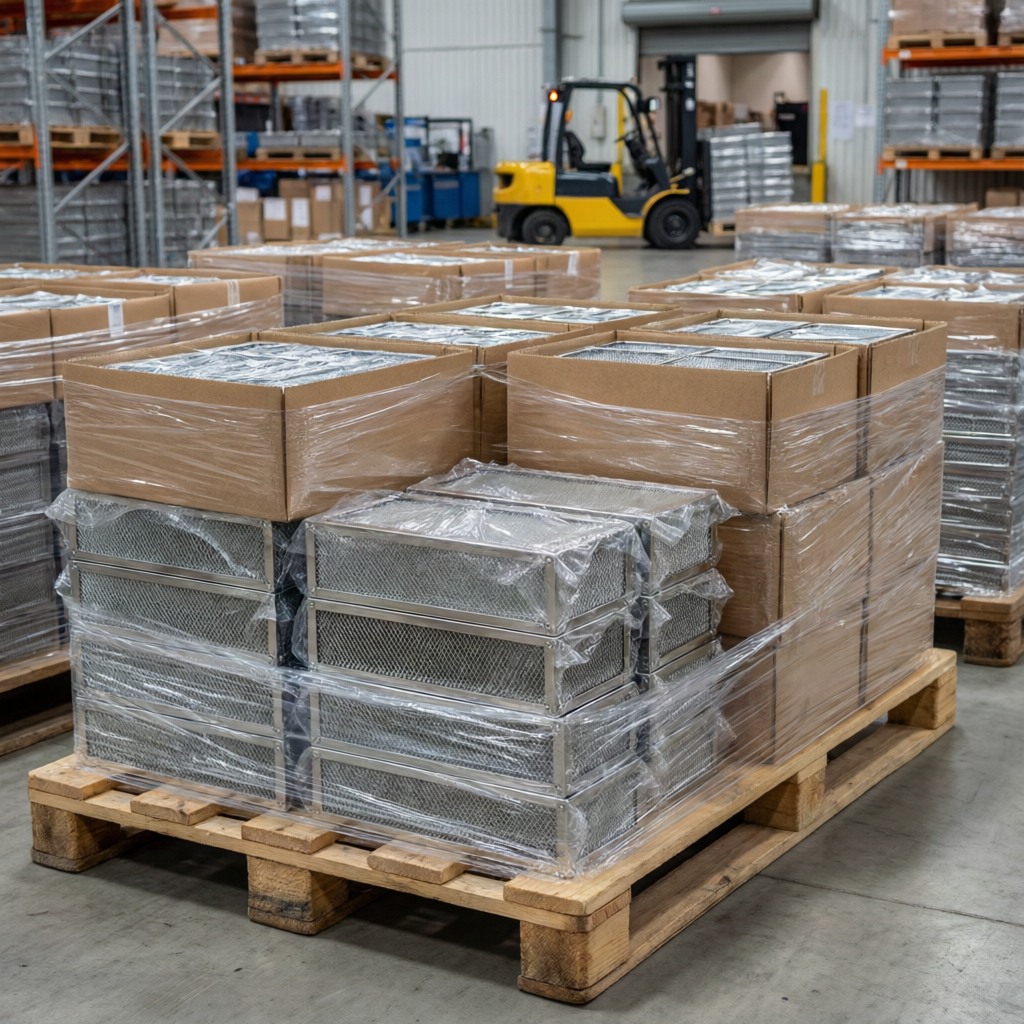
Filters pack in rigid cartons on pallets to the container plan, with corner guards and steel strapping.
Label by specification
Every package carries size, construction, material, quantity, and production lot for receiving checks.
Certificates on request
Material certificates and inspection reports accompany the shipment when ordered; third-party inspection is available on request.
Mesh Grease Filters in Service
Use scenarios show how construction, material, and size change by duty; they are not customer claims.

Restaurant hood OEM assembly
Double-layer 430 stainless mesh grease filters in welded frames, 24 + 30 mesh, cut to the hood slot drawing and fitted with riveted pull handles.

Chain kitchen replacement stock
Standard 16 x 20 inch 304 stainless cassettes stocked for scheduled swaps across multiple locations, with lot labels for traceability.

Food plant washdown service
304 stainless double-layer grease filters with gasket edges on process exhaust hoods, cleaned in a caustic washdown cycle.
Export distributor program
Mixed-size aluminum and stainless mesh grease filter packs, individually wrapped and palletized for a distributor restocking program.
Grease Filter Sourcing Resources
Compare woven filter media, alloys, and related categories. Confirm the standard edition and project requirements before ordering.
Last updated: 2026-08-25
Related pages
Reference standards
Grease Filters FAQ
Common procurement questions about mesh grease filter materials, construction, sizes, compliance, and ordering.
Still have questions about grease filters?
Send your hood slot size, mesh combination, material, quantity, cleaning regime, and destination. Our sourcing team replies with a specification-led review.
Request a QuoteRequest Grease Filter Pricing
Send slot dimensions or drawing, mesh combination and wire diameter, material, layer construction, frame and handle style, quantity, application, and destination for a specification-led sourcing review. Our team replies with matched mesh grease filter options and a factory quote.
Your details stay private. We reply with a matched factory quote — no spam.