Hastelloy Wire Mesh: C-276 Specs & Sourcing
Specify Hastelloy wire mesh for corrosive process screening and filtration. Use this C-276 / UNS N10276 guide to define mesh geometry, weave, finished form, quality evidence, and the process conditions needed before quotation.
View SpecificationsHastelloy C-276 Wire Mesh Specifications
HASTELLOY® C-276 is a nickel-chromium-molybdenum alloy identified as UNS N10276. The alloy designation alone does not define a wire mesh: the RFQ must also define the wire-cloth geometry, weave, finished form, process medium, operating conditions, and acceptance evidence. ASTM E2016 and ISO 9044 are useful references for square-aperture industrial woven wire cloth; ASTM E2814 is relevant when Dutch weave filter cloth is required.
Specify Alloy C-276 / UNS N10276. HASTELLOY® is a registered Haynes International trademark; the exact mill source and material certificate route should be agreed before production.
Published C-276 data describes a wrought nickel-chromium-molybdenum alloy with resistance to several corrosive environments, including chloride-related pitting and crevice attack. It is not a universal compatibility approval.
State mesh count per linear inch or required opening, wire diameter, calculated or required open area, width, length, and permissible tolerances. Mesh count alone does not define the aperture.
Name plain, twill, plain Dutch, twill Dutch, or another agreed construction, then state whether the item is a roll, sheet, disc, framed screen, insert, or fabricated part.
Provide the medium, concentration, chlorides or oxidizers, temperature range, pressure differential, flow direction, cleaning chemistry, and any welding or fabrication exposure for engineering review.
Request the agreed MTC, dimensional checks, sample, marking, inspection-photo, packing, and PMI scope in the RFQ. Agree any acceptance criteria before production begins.
| Selection point | C-276 / UNS N10276 context | What to confirm in the RFQ | |
|---|---|---|---|
| Alloy identity | C-276 is a nickel-chromium-molybdenum alloy. Haynes identifies it as UNS N10276. | State C-276 / N10276, any required governing material standard, mill certificate needs, and whether approved equivalents are allowed. | |
| Corrosion environment | Published data reports strong resistance in many corrosive environments, including chloride-bearing conditions, but corrosion behavior changes with the complete exposure. | Provide chemistry, concentration, temperature, aeration, impurities, flow, pressure, and cleaning cycle. Obtain application-specific compatibility approval. | |
| Square-aperture cloth | ASTM E2016 and ISO 9044 address industrial woven wire cloth terminology, tolerances, and testing for their stated scopes. | State mesh count, wire diameter, aperture, open area, weave, width, length, and the required standard edition or tolerance. | |
| Dutch weave filter cloth | ASTM E2814 covers industrial woven wire filter cloth, including Dutch weave, where retention or pore-size acceptance is relevant. | State retention target, flow direction, pressure differential, cleaning method, fabric dimensions, and performance or acceptance test requirement. | |
| Finished screen or insert | Frames, edges, joints, and support components can affect fit and service behavior as much as the wire cloth itself. | Provide drawing, final dimensions, edge condition, flatness, mounting interface, joining method, component materials, quantity, and destination. |
Hastelloy C-276 Wire Mesh RFQ Checklist
These fields establish a comparable quotation basis. Availability, lead time, and final dimensions are confirmed only after the complete requirement is reviewed.
| RFQ field | What to provide | Why it matters | |
|---|---|---|---|
| Alloy | C-276 / UNS N10276 and any required standard, certificate, or approved-equivalent policy | Prevents a grade assumption or undocumented substitution. | |
| Mesh geometry | Mesh count or opening, wire diameter, aperture, open area, tolerance, width, and length | Defines the screen geometry and the basis for dimensional acceptance. | |
| Construction | Plain, twill, Dutch, or other agreed weave; warp and shute details for filter cloth where needed | Changes flow behavior, surface profile, fabric thickness, and suitable acceptance criteria. | |
| Finished form | Roll, sheet, disc, framed screen, insert, or fabricated part; drawing and edge requirements | Aligns weaving, fabrication, packing, and installation interfaces. | |
| Process conditions | Medium, concentration, temperature, pressure, flow direction, contaminants, cleaning, and required service review | Material behavior depends on the actual duty, not the alloy name alone. | |
| Inspection and logistics | MTC, sample, dimensions, PMI, marking, packing, quantity, destination, and required date | Sets the evidence and delivery basis before a quotation is issued. |
Specify the Construction Alongside C-276
A material name does not define a finished wire mesh. The construction controls aperture, thickness, flow path, surface profile, strength, and fabrication options, so it belongs in the RFQ with the C-276 designation.
Plain woven C-276 mesh
A one-over, one-under construction used where a square opening is required. Specify mesh count, wire diameter, aperture, open area, and tolerance together.
Twill woven C-276 mesh
A two-over, two-under construction that can support different fine-mesh combinations. Define the required opening, wire, thickness, handling, and inspection needs rather than using the weave name alone.
Dutch weave C-276 filter cloth
A dense filtration construction with different wire combinations in each direction. Define retention target, flow direction, pressure differential, cleaning method, and acceptance requirement for engineering review.
Cut and fabricated mesh parts
Discs, framed screens, inserts, and assemblies require the wire-cloth geometry plus final drawing, dimensions, edge condition, flatness, joining method, and material requirements for every component.
Where Hastelloy C-276 Wire Mesh May Be Considered
These are illustrative industrial selection scenarios, not customer projects, performance claims, or material-compatibility approvals. Review the actual process chemistry and operating conditions before selecting an alloy or releasing production.
Chemical process filtration
Woven C-276 mesh may be evaluated for screens and filter media where the specified process duty needs a corrosion-resistant nickel alloy. Confirm the full chemistry, temperature, contaminants, retention target, and cleaning regime.
Flue-gas and scrubber internals
Mesh may be evaluated for demisting, separation, or support roles in named flue-gas-treatment equipment. Define gas composition, condensate chemistry, chlorides, temperature, cycling, and every component material.
Gas-liquid separation
A woven or knitted mesh route can be assessed for a coalescing or demisting assembly when the required droplet behavior, pressure loss, fluid chemistry, flow direction, and cleaning method are known.
Pulp, bleaching, and waste treatment equipment
C-276 may be reviewed for specified process screens or filtration parts in corrosive treatment duties. Specify the actual liquor, oxidizers, chlorides, temperature, and maintenance chemicals rather than naming the industry alone.
Fine liquid or gas filtration
Plain, twill, or Dutch woven cloth can be considered where a defined screen geometry and corrosion-resistant alloy are required. Match the construction to retention, pressure differential, flow, and cleanability.
Fabricated replacement screens
Equipment-specific discs, framed panels, and inserts need a drawing, mesh construction, interface dimensions, edge treatment, joining details, and inspection plan in addition to the requested alloy.
How to Select Hastelloy Wire Mesh
Treat C-276 wire mesh as an engineered component. Start with the duty, then lock the alloy identity, mesh construction, finished form, and acceptance evidence before asking for a comparable quotation.
Define the complete exposure
State each medium, concentration, oxidizer, chloride, contaminant, temperature, pressure, flow, cleaning chemical, and upset condition. A material name does not replace compatibility review.
Name C-276 by UNS designation
Use C-276 / UNS N10276 and state whether an equivalent alloy is permitted. Tie any required chemistry or documentation to the RFQ and purchase order.
Define geometry, not mesh count alone
Give mesh count or target opening, wire diameter, aperture, open area, tolerance, and fabric dimensions. Different wire diameters can yield different openings at the same mesh count.
Match the weave to the job
Use square-aperture cloth for its specified screen geometry; use a Dutch-weave route only after retention, flow direction, pressure differential, and cleaning needs are defined.
Agree the acceptance route early
Set MTC, sample, dimensional, PMI, fabrication, marking, packing, and inspection requirements before production. Confirm how any critical property will be verified.
Five C-276 Mesh Errors That Create Rework
Most issues begin with an incomplete process or mesh specification rather than the quotation itself.
Ordering “Hastelloy mesh” without the grade
The HASTELLOY® name covers multiple alloys. Specify C-276 / UNS N10276 when that is the required grade, and state whether alternatives are acceptable.
Treating C-276 as a blanket corrosion approval
Corrosion behavior changes with concentration, temperature, oxidizers, chlorides, contaminants, aeration, flow, and fabrication. Submit the actual duty for application-specific review.
Using mesh count as the entire specification
The same mesh count can use different wire diameters and give different apertures, open areas, weight, thickness, and pressure-drop behavior.
Applying square-mesh rules to Dutch filter cloth
Dutch weave uses a different construction and is commonly specified by retention or pore-size performance. Include flow direction, pressure differential, and acceptance method.
Ignoring the finished assembly
Frames, welds, edge treatment, support components, and mounting interfaces can control fit and service behavior. Provide a drawing and materials for every fabricated component.
Benefits and Boundaries of Hastelloy C-276 Wire Mesh
Published alloy information helps frame selection, while the exact mesh specification and process duty determine whether the component is suitable. This page supports an engineering RFQ; it does not certify a process application.
A defined nickel-alloy route
Naming C-276 / UNS N10276 creates a clear material starting point for a mesh RFQ, material certificate review, and any required approved-equivalent decision.
Corrosion-focused alloy selection
Haynes publishes C-276 as a nickel-chromium-molybdenum alloy with strong resistance in many corrosive environments, including chloride-related pitting and crevice attack. Process-specific validation still applies.
Choice of woven construction
Plain, twill, and Dutch constructions can be specified independently from the alloy so screening, filtration, support, and fabrication requirements remain explicit.
Measurable screen geometry
Wire diameter, mesh count, aperture, open area, weave, thickness, and finished dimensions can be agreed as separate acceptance fields instead of relying on a generic mesh label.
Specification-led sourcing support
WireMesh Sourcing’s existing process supports factory matching, dimensional inspection, MTC document coordination, agreed alloy-screening checks, and export-packing planning against the final specification.
Clear limits on the page claim
The page makes no stock, lead-time, price, service-life, or universal compatibility promise. Final supply and application suitability require review of the complete RFQ.
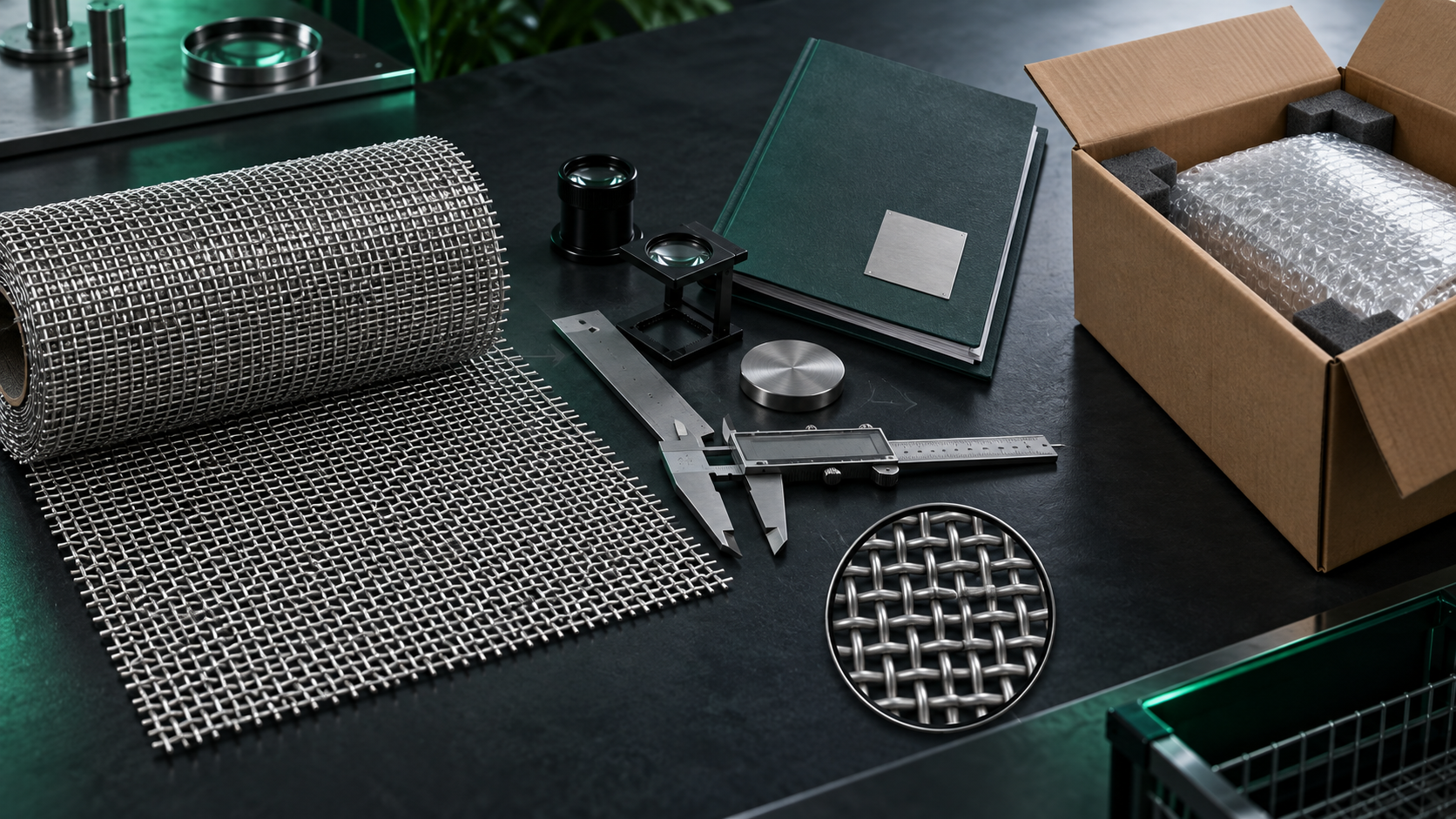
Illustrative workflow: use the complete duty, mesh geometry, acceptance evidence, and logistics requirements to create a quotation-ready specification.
Turn Process Data Into a C-276 Mesh RFQ
Document the process duty
Provide media, concentration, chlorides or oxidizers, temperature range, pressure, flow direction, contaminants, cleaning method, and any application-specific requirements.
Fix alloy and mesh construction
State C-276 / UNS N10276, mesh count or target opening, wire diameter, aperture, open area, weave, roll or finished form, dimensions, and edge condition.
Agree acceptance evidence
Set the MTC, sample, dimensional, PMI, retention, fabrication, or inspection-photo requirements that apply before production starts.
Confirm packing and destination
State quantity, destination, required date, packing constraints, and handling needs so the final quote reflects the actual export requirement.
Packing Follows the Finished Mesh Requirement
Packing is confirmed after the final mesh form, dimensions, edge sensitivity, quantity, destination, and handling requirements are known. Do not assume that a roll, cut disc, or framed insert needs the same protection method.
Protect the wire-cloth geometry
Identify the finished form and any edge, flatness, or surface-protection constraint so the proposed packing matches the component rather than a generic mesh roll.
Keep agreed evidence with the shipment
State material certificate, inspection-photo, marking, packing-record, and identification needs with the order so documentation is planned with production.
Scope export handling early
Confirm destination, consignment grouping, handling constraints, and required date before packing is finalized. WireMesh Sourcing coordinates export-ready packing against the agreed specification.
Hastelloy Wire Mesh in Engineering Context
These images are generated technical illustrations, not customer projects, inventory photographs, performance claims, or application approvals.

Chemical filtration screen
Illustrative view of a woven alloy mesh screen in a process filtration assembly. Confirm the actual medium, retention target, pressure differential, and cleaning requirement before selection.
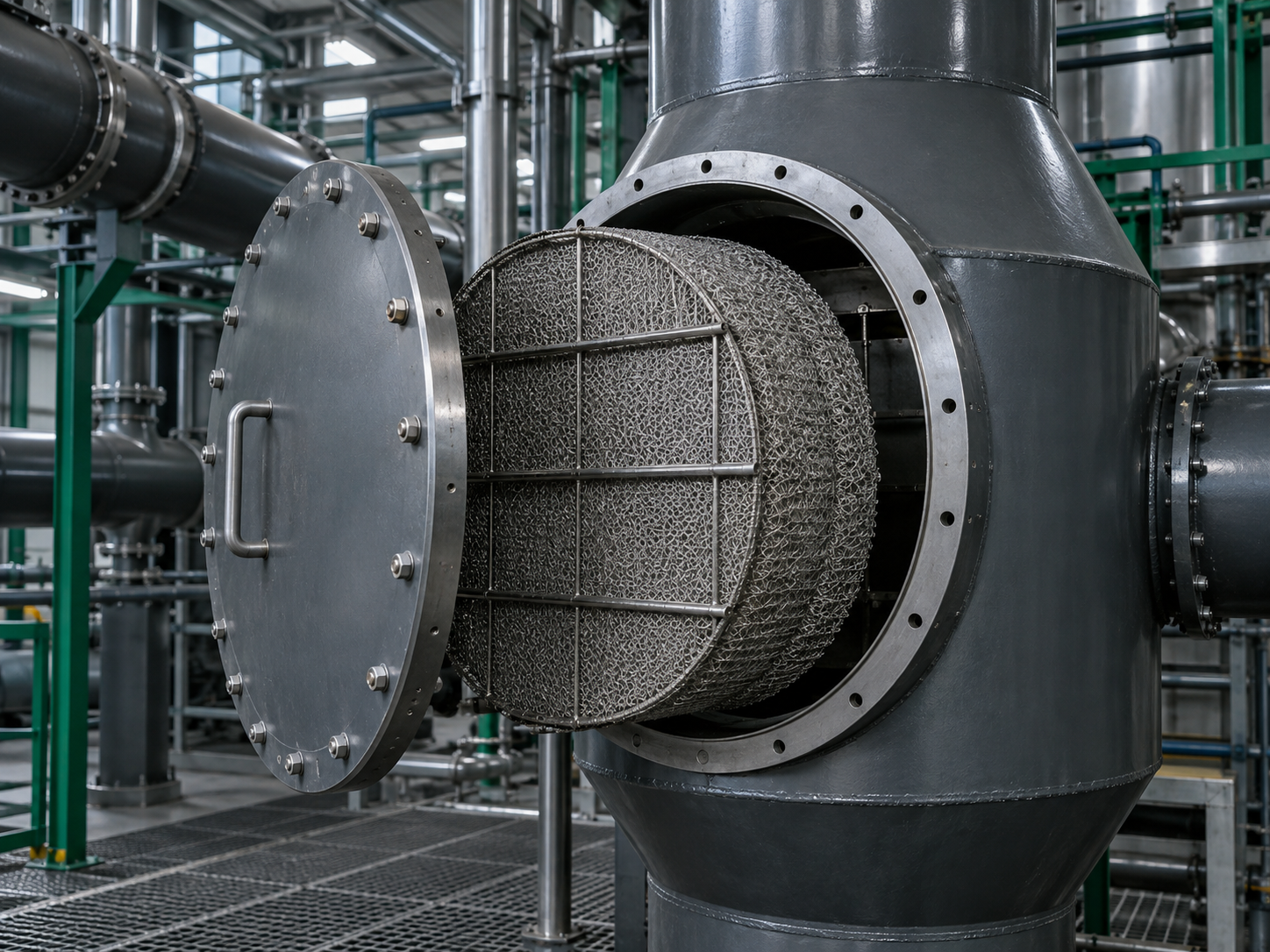
Flue-gas-treatment internals
Illustrative view of a mesh demisting or separation component in generic treatment equipment. Define gas and condensate chemistry, chlorides, temperature, cycling, and component materials.

Gas-liquid separation element
Illustrative view of a mesh coalescing element. Flow, droplet target, pressure loss, liquid chemistry, installation orientation, and maintenance approach belong in the engineering review.
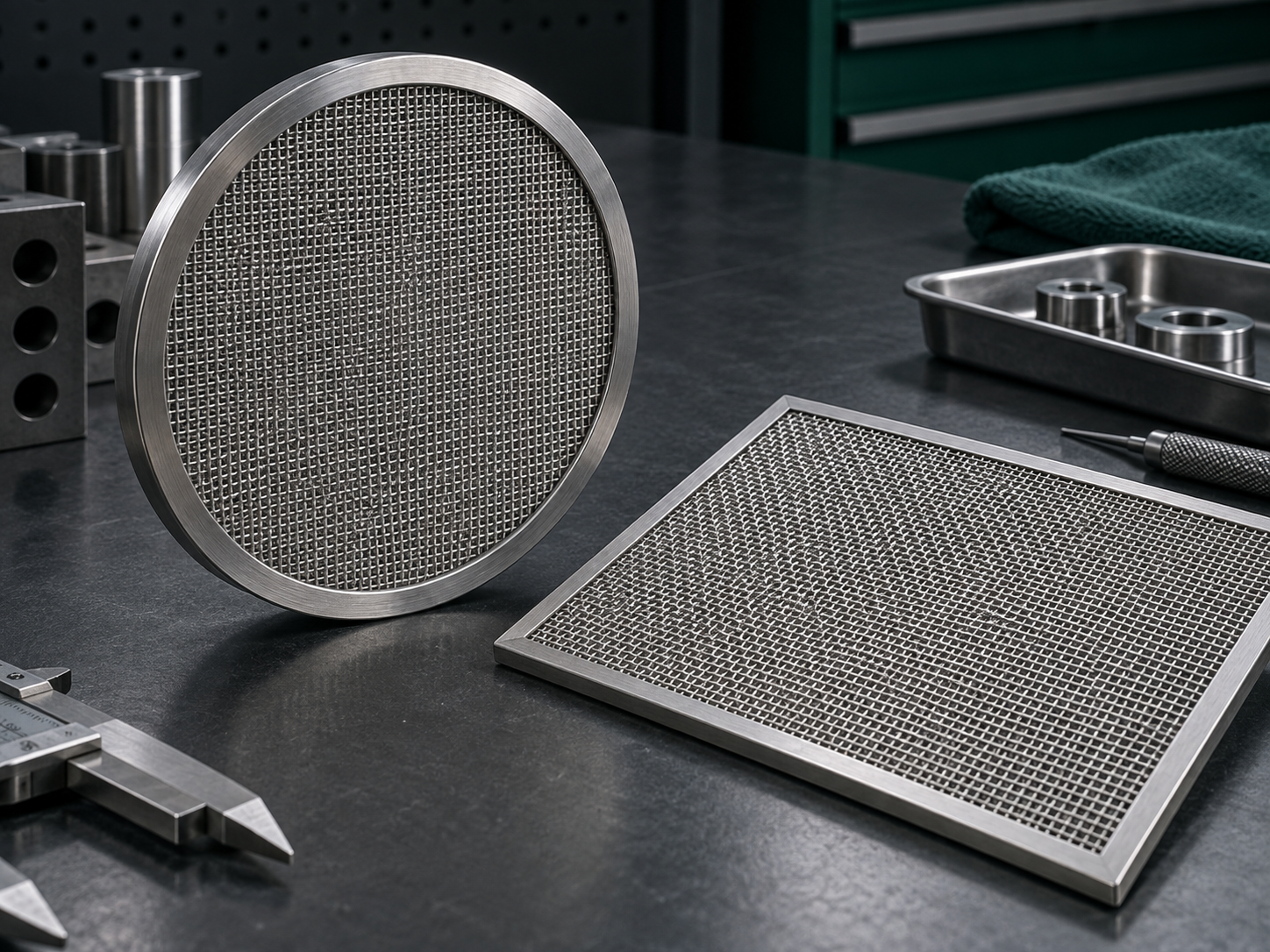
Fabricated mesh screen
Illustrative finished disc and framed panel. A quote-ready drawing must specify mesh construction, dimensions, edge treatment, mounting interface, and every component material.
Hastelloy C-276 Wire Mesh References
Use these resources to frame a specification, verify the applicable edition and scope, and agree acceptance criteria with the project team before ordering.
Last updated: 2026-09-24
Related pages
Reference standards
Hastelloy Wire Mesh FAQ
Answers for buyers preparing a C-276 / UNS N10276 mesh inquiry for screening, filtration, separation, or a fabricated replacement part.
Need help defining C-276 wire mesh?
Send the alloy designation, mesh geometry, finished form, process duty, documentation needs, quantity, and destination. We will align the factory review, inspection route, and export-packing scope before quoting.
Request a QuoteRequest Hastelloy C-276 Wire Mesh Pricing
Send C-276 / UNS N10276, mesh count or opening, wire diameter, weave, finished form, dimensions, process duty, quantity, documentation needs, and destination for a comparable sourcing review.
Your details stay private. We reply with a matched factory quote — no spam.