EMI Shielding Mesh: Copper, Brass & Stainless Steel Wire Mesh for RF and Electromagnetic Shielding
Source EMI shielding mesh in copper, brass, and stainless steel, in woven, knitted, and expanded constructions, for Faraday cages, shielded rooms, RF gaskets, and vent panels. Compare materials, mesh counts, and shielding notes, then request a factory quote.
View SpecificationsEMI Shielding Mesh Specifications
Shielding mesh is defined by material, construction, mesh count, wire diameter, and aperture together. Mesh count alone does not set the shielding result: opening, contact continuity at seams, and grounding dominate. Confirm the target frequency band and verify the finished assembly.
Copper (C11000 ETP, C10100 OFHC), brass, and stainless steel 304/316, chosen by conductivity, corrosion, environment, and cost
Woven wire cloth, knitted wire mesh, expanded mesh, and framed or fabricated assemblies
Mesh count per linear inch, wire diameter, aperture, and open area; woven shielding cloth commonly 16-200 mesh in stainless steel and 16-120 mesh in copper
Attenuation depends on opening size, wire contact, and seam continuity, not on mesh count alone; match the mesh to the target band and verify with a test
Rolls, sheets, panels, cut-to-size and framed vent panels, knitted tape and gasket strip
Mill certificates, dimensional checks, and shielding-effectiveness testing on the finished assembly per the relevant standard
| Material | Typical shielding role | Why it is used | RFQ note | |
|---|---|---|---|---|
| Copper | RF gaskets, Faraday cages, high-frequency shielded rooms | Highest conductivity of the common mesh metals at about 100% IACS, and easy to solder | State CDA grade (C11000 ETP or C10100 OFHC), mesh count, and wire diameter | |
| Brass | Moderate-frequency vent panels, enclosures, and screening | Good conductivity at about 23-28% IACS by alloy, spark-resistant, and lower cost than copper | State the alloy; brass tarnishes in wet or humid service | |
| Stainless steel 304/316 | Structural, outdoor, chemical, and marine screening | Corrosion resistance and strength at low cost; lower conductivity at about 2-3% IACS | Confirm grade and finish; choose where corrosion matters more than attenuation | |
| Aluminum | Lightweight shielding panels and vent screens | Good conductivity per unit weight and corrosion resistance in dry indoor service | Confirm alloy and any anodized or coated finish |
EMI Shielding Mesh Selection Guide
A practical starting point by target frequency and airflow. Shielding performance depends on mesh density, wire diameter, and contact continuity, so verify with samples before bulk production.
| Shielding target | Recommended mesh | Selection note | |
|---|---|---|---|
| Under 100 MHz: general rooms and cabinets | 40 mesh (0.385 mm aperture) | The balanced starting point between shielding and airflow | |
| 100 MHz to 1 GHz | 60-80 mesh | Smaller apertures block more; check that thicker wire does not cut the open area | |
| Above 1 GHz: sensitive electronics | 80-120 mesh, or double layers | Stagger double layers to avoid resonant slot effects at seams | |
| Airflow first: ducts and filter faces | 20-40 mesh | Start at 40 mesh and open up only if the airflow budget fails | |
| Serviceable openings and gasket joints | Knitted copper strip | Flexible knitted mesh keeps continuous contact that foil cannot hold | |
| Ventilation windows on shielded doors | 60 mesh framed panel | Frame the mesh with a conductive gasket; the seam leaks more than the mesh | |
| Test enclosures and lab Faraday cages | 40-80 mesh by band | Seam and door treatment dominate the result; plan a full-enclosure test |
Shielding Materials Compared
The same comparison criteria applied to the four common shielding mesh metals, based on published copper alloy data.
| Factor | Copper | Brass | Stainless 304/316 | |
|---|---|---|---|---|
| First cost | Highest per kg | Middle | Lowest | |
| Electrical conductivity | Excellent; about 100% IACS | Good; about 23-28% IACS by alloy | Lower; about 2-3% IACS | |
| Outdoor and coastal life | Patina forms but metal stays sound | Tarnishes; dezincification risk in seawater | Decades; no coating to fail | |
| Spark resistance | Spark-resistant | Spark-resistant | Can spark on impact | |
| Best for shielding | High-frequency shielding, gaskets, and Faraday cages | Moderate-frequency vent panels and spark-safe duty | Structural, outdoor, and corrosion-resistant screening |
EMI Shielding Mesh RFQ Checklist
Providing these fields lets the sourcing and factory teams evaluate a comparable shielding requirement instead of quoting against an incomplete mesh description.
| Field | What to state | Why it matters | |
|---|---|---|---|
| Target frequency band and attenuation | Operating or test band and the attenuation or test standard | Sets mesh count, material, and construction together | |
| Material and grade | Copper C11000/C10100, brass alloy, or stainless 304/316 | Prevents a conductivity or corrosion assumption | |
| Construction | Woven, knitted, expanded, or framed | Changes flexibility, airflow, and contact behavior | |
| Mesh geometry | Mesh count, wire diameter, aperture, and open area | Defines the opening and the shielding result together | |
| Seams, mounting, and grounding | Joint detail, frame, and grounding method | Seams and grounding dominate real shielding performance | |
| Form and dimensions | Roll, sheet, panel, gasket strip, and size | Sets fabrication and fit | |
| Quantity and destination | Quantity, destination port, and trade term | Prices material, processing, and freight | |
| Acceptance | MTC, attenuation test, inspection, and sample need | Aligns documentation and verification |
EMI Shielding Mesh Constructions We Source
Woven cloth, knitted mesh, expanded panels, and framed assemblies cover most shielding tasks. Compare flexibility, airflow, and attenuation before you specify.
Woven shielding mesh
Square or twill woven cloth in copper, brass, or stainless steel, commonly 16-200 mesh; the main route for Faraday cages, shielded rooms, and vent screens where defined apertures matter.
Knitted EMI shielding mesh
Loop-constructed knitted copper or brass mesh that flexes with the joint, used for RF gaskets, pipe wraps, and seam sealing where continuous contact is required.
Expanded and perforated shielding panels
Slit-and-stretched or punched sheet forming rigid conductive panels for ventilation screens and enclosure inserts where strength and airflow matter.
Framed and fabricated shielding assemblies
Cut-to-size and framed vent panels, conductive gasket strips, and finished assemblies supplied for direct installation into shielded enclosures.
How to Select EMI Shielding Mesh
Start from the target frequency band and required attenuation, then fix material, construction, mesh count, seams, and grounding. A complete RFQ avoids re-quotes and test failures.
Define the frequency band and attenuation target
Name the operating or test frequency band and the attenuation you must meet. The band drives every later choice.
Choose the material
Copper for highest conductivity, brass for a cost balance, stainless steel where corrosion or strength dominates, and aluminum for lightweight panels.
Choose the construction
Woven for defined apertures, knitted for flexible gaskets, expanded or perforated for rigid panels, and framed for drop-in assemblies.
Fix the mesh geometry
Mesh count, wire diameter, aperture, and open area together define the opening and the shielding; mesh count alone is not enough.
Balance shielding against airflow
For vents and racks, denser mesh blocks more interference but chokes cooling; start from the band and open up only if the airflow budget fails.
Plan seams, mounting, and grounding
Seams leak more than the mesh; overlap or gasket them and ground the mesh to the frame and system reference.
Choose the form and finish
Roll, sheet, panel, gasket strip, or framed unit; state dimensions, edge condition, and any finish requirement.
State testing and acceptance
Mill certificates, attenuation testing on the finished assembly, and sample needs keep the RFQ comparable and the result verifiable.
Why Buyers Choose EMI Shielding Mesh
EMI shielding mesh blocks interference while keeping airflow and visibility. Choose it for verifiable reasons: material-matched conductivity, seam-first design, and fabrication-ready supply.
Broadband shielding that still breathes
Woven and expanded mesh reduce radiated interference while allowing airflow and visibility, unlike solid foil.
Conductivity matched to the band and budget
Copper, brass, and stainless steel routes match conductivity to the frequency band and cost target.
Flexible knitted routes for gaskets and joints
Knitted mesh flexes with seams and serviceable openings, holding continuous contact that rigid mesh cannot.
Fabrication-ready formats
Rolls, sheets, panels, and framed assemblies arrive ready for installation and fabrication.
Cost-matched material routes
Choose stainless for structure, brass for balance, copper for maximum attenuation, and keep the budget in view.
Specification-led QC and traceability
Material test certificates, dimensional checks, and labeled lots give traceable, inspectable supply.
Where EMI Shielding Mesh Is Used
EMI shielding mesh blocks electromagnetic and radio-frequency interference in enclosures, rooms, and vents while allowing airflow and visibility. Confirm the frequency band and duty in the RFQ.
Faraday cages and shielded enclosures
Copper or stainless steel woven mesh used to build Faraday cages and shielded enclosures that block external electromagnetic and radio-frequency fields while protecting sensitive electronics and test equipment.
Shielded rooms, MRI suites, and EMC test labs
Shielding mesh installed on the walls, windows, and doors of shielded rooms, MRI suites, and EMC test labs, where seam and door treatment decide the result as much as the mesh itself.
Vent panels and rack airflow screens
Mesh vent panels and rack airflow screens balance shielding against cooling, keeping enclosures within a thermal budget while reducing radiated emissions or ingress.
RF, telecom, and data-center equipment
Copper or brass shielding mesh used in RF, telecom, and data-center equipment to reduce radiated interference and improve signal integrity in tight enclosures.
Military, medical, and aerospace electronics
Copper, brass, and stainless steel shielding mesh specified by frequency band and environment for military, medical, and aerospace electronics where EMC compliance and reliability matter.
EMI/RFI gasket mesh and knitted strips
Knitted copper mesh and conductive gasket strips provide flexible, continuous contact across seams and serviceable openings, maintaining the shield where rigid mesh cannot.
EMI Shielding Mesh Buying Mistakes to Avoid
Six errors that lead to a shielded assembly that fails its test. Every one is avoidable at the RFQ stage.
Specifying mesh count alone
Mesh count without wire diameter and aperture does not define the opening. State the full geometry.
Ignoring seams and joints
Seams and doors leak more than the mesh face. Plan overlaps, gaskets, and continuous contact.
Picking material by name, not by band and environment
The frequency band and service environment decide copper, brass, or stainless, not the material name alone.
Using woven mesh where a knitted gasket is needed
Moving or serviceable joints need flexible knitted gasket mesh to keep continuous contact.
Treating the mesh as a shield without grounding
An ungrounded mesh does not shield reliably. Ground it to the frame and system reference.
Skipping the attenuation test
Verify the finished assembly against the target band; untested mesh assumptions fail at final EMC tests.
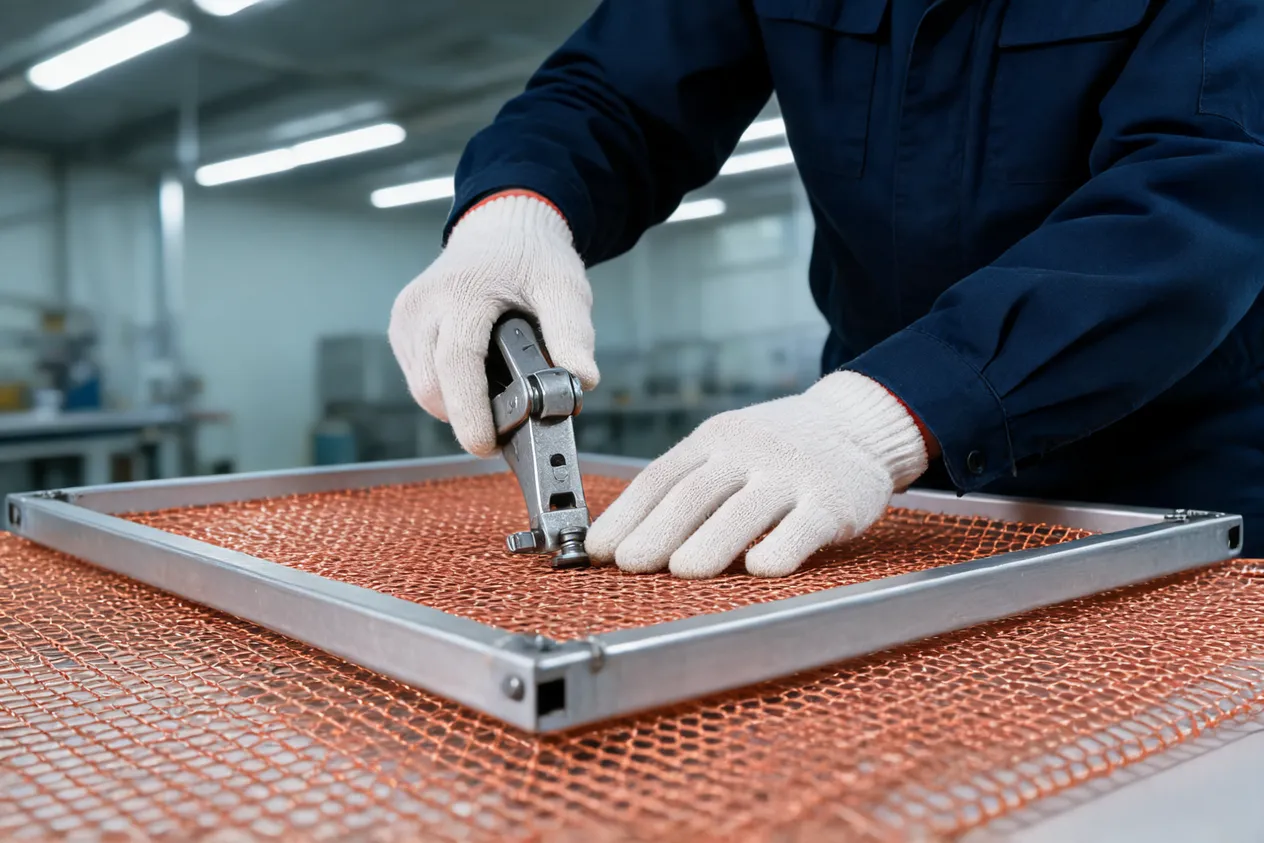
Mesh is supplied as rolls, sheets, panels, or gaskets and finished into a shield with clean cutting, continuous contact at seams, and proper grounding.
Installing EMI Shielding Mesh
Cut along the wire line
Cut woven mesh along the wire direction and deburr edges so loose wires do not lift and break contact.
Fix with continuous contact
Overlap seams or seat a conductive gasket so there is no slot or gap in the shield.
Ground the mesh
Connect the mesh to the frame and system ground; without a ground the shield cannot work.
Test the finished assembly
Verify attenuation across the target band and re-check seams, doors, and service openings.
EMI Shielding Mesh Packing for Export
Packing protects fine wire from crushing and scratching and preserves traceability through transit and receiving inspection.
Rolls and sheets protected
Mesh is wrapped and edge-protected so fine wire is not crushed or scratched in transit.
Flat panels protected
Panels are packed flat with edge and corner protection against handling damage.
Labeled by specification
Each lot carries material, mesh count, wire diameter, dimensions, quantity, and lot number.
Certificates on request
Material test certificates and dimensional inspection reports accompany the shipment when ordered.
Share destination details
State destination port, trade term, and inspection requirements; pre-shipment inspection by SGS, BV, or TÜV is available on request.
Factory QC before shipment
Incoming wire, weaving or knitting, finishing, and final inspection happen before dispatch.
EMI Shielding Mesh in Service
Use scenarios show how material, construction, and mesh count change by duty; they are not customer claims.
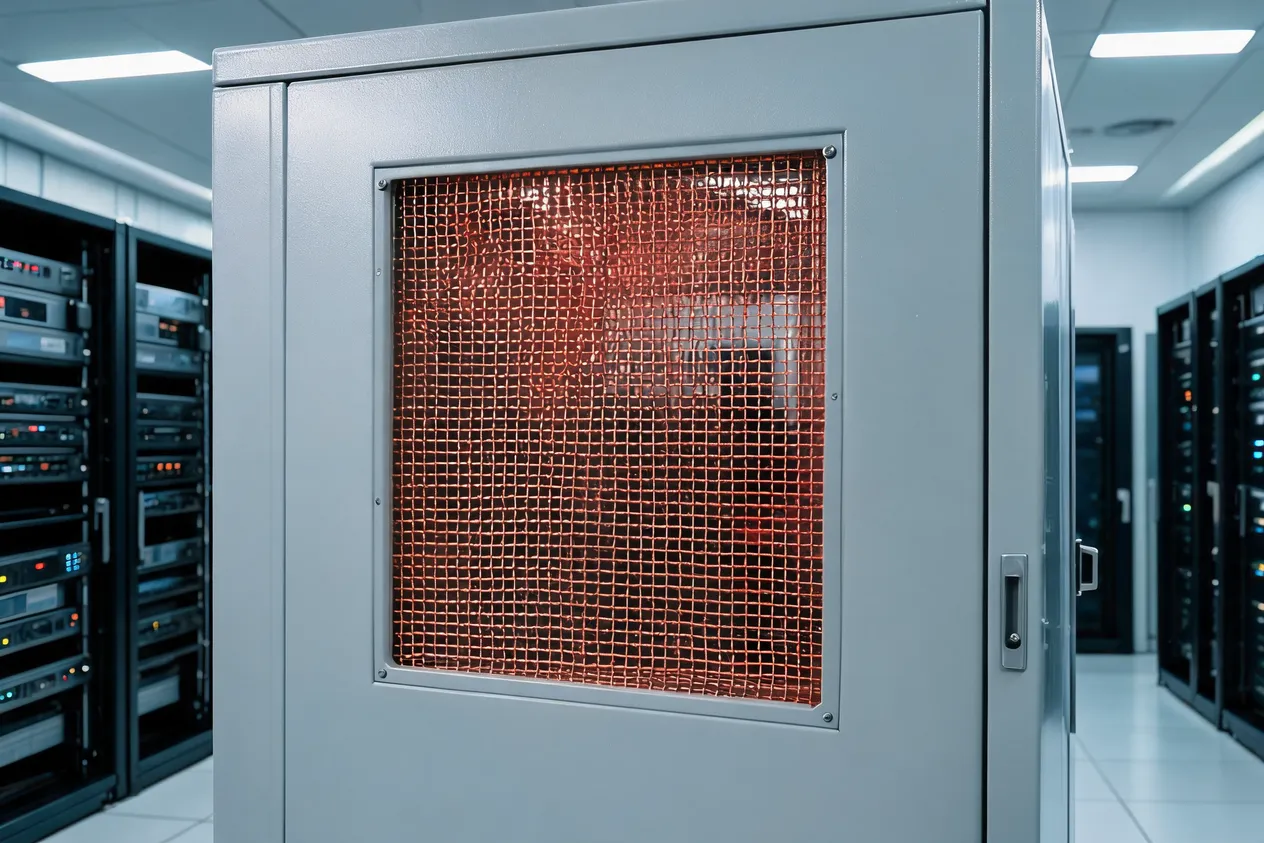
Faraday cage enclosure
Copper woven mesh at 40-80 mesh framed into a Faraday cage, sized to the target band and verified with a full-enclosure test.
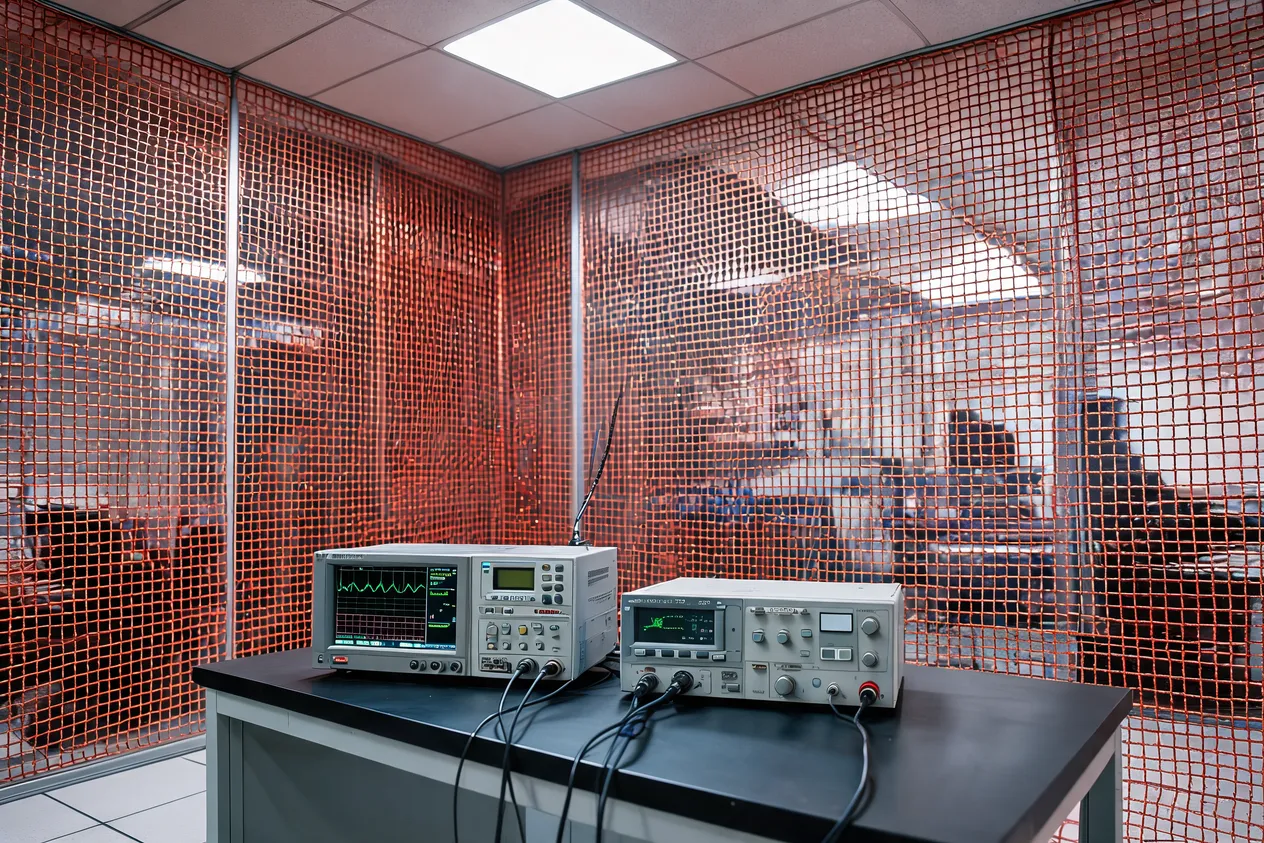
Shielded laboratory and EMC test room
Copper mesh lining the walls and windows of a shielded lab, where seams and door gaskets dominate the result.
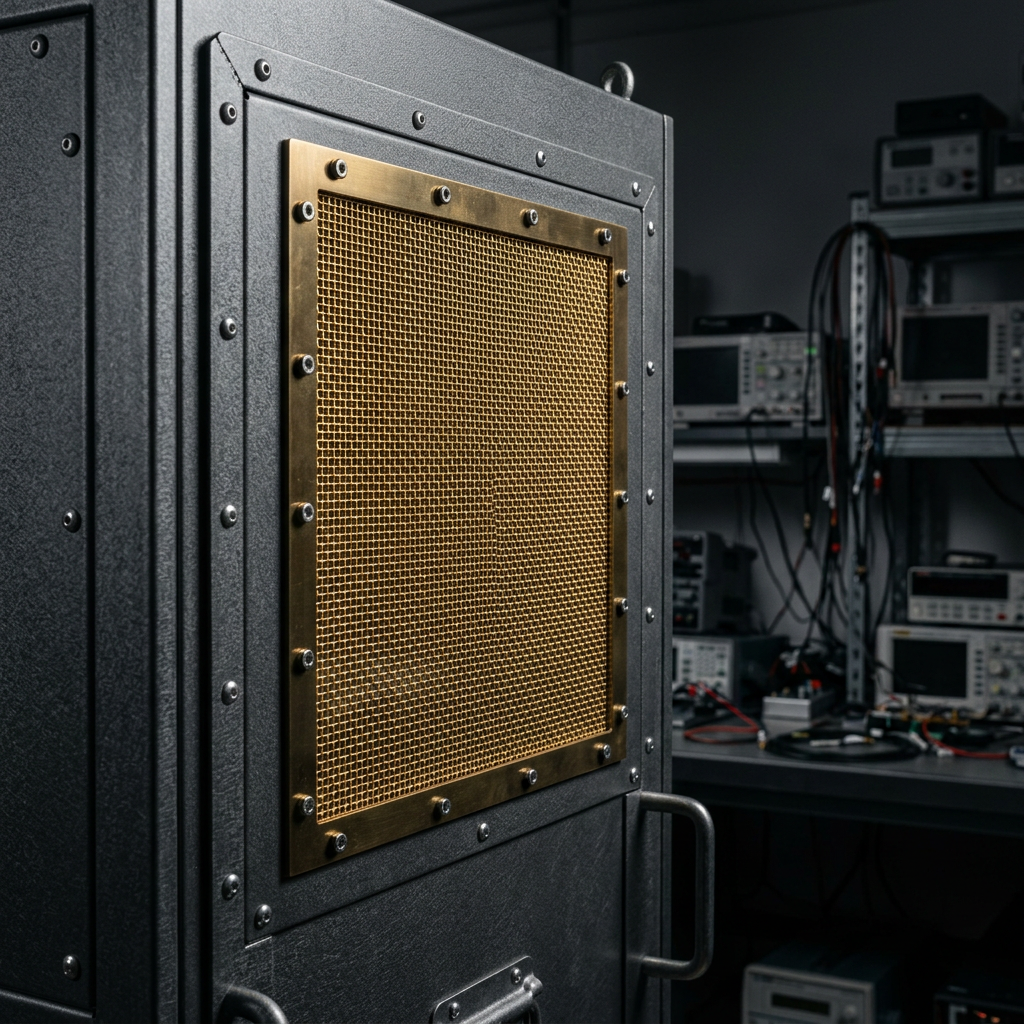
RF gasket and joint sealing
Knitted copper mesh strip seated across a serviceable seam to maintain continuous contact on a door or panel.
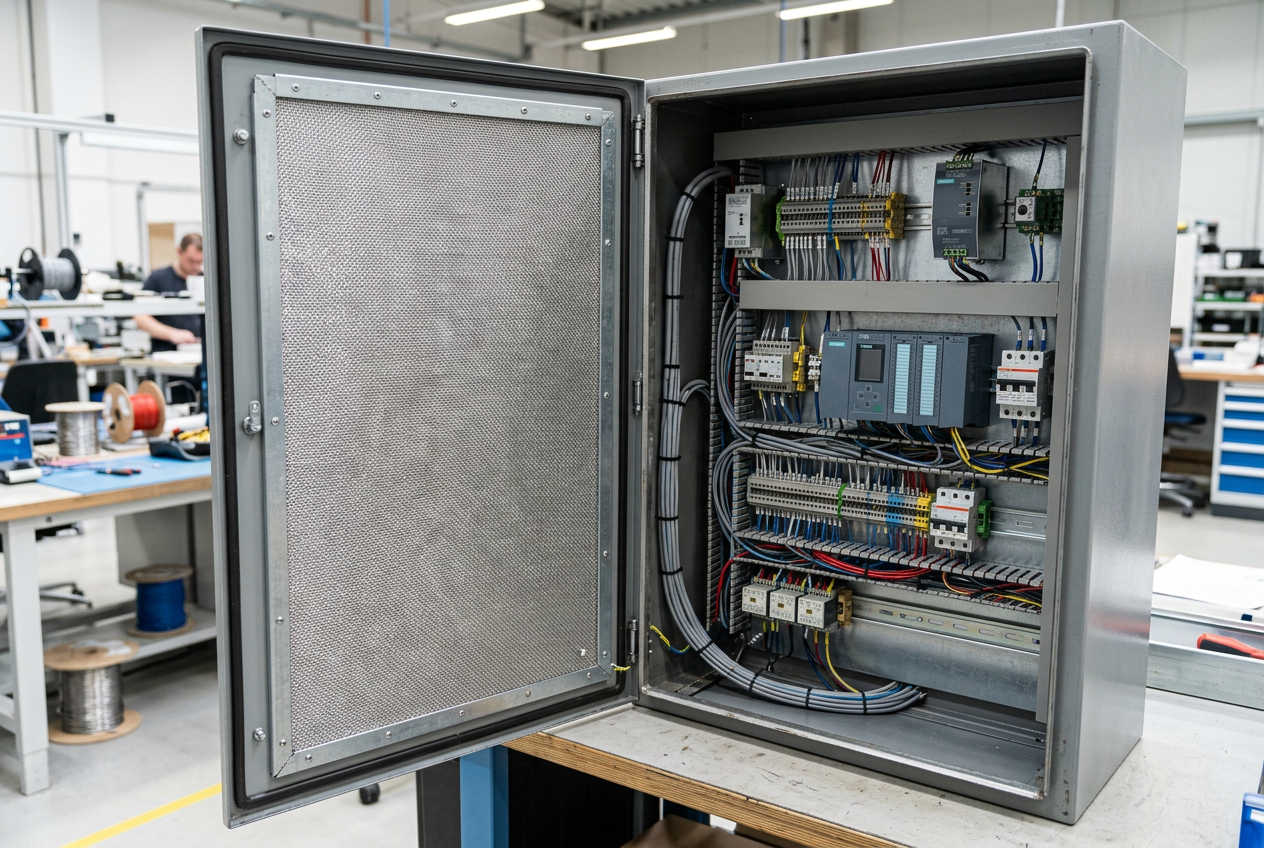
Vent shielding panel
A 60 mesh framed panel over an equipment-rack vent, balancing shielding with the cooling airflow budget.
EMI Shielding Mesh Sourcing Resources
Compare material grades, constructions, and related categories. Confirm the standard edition and your target frequency band before ordering.
Last updated: 2026-09-21
Related pages
Reference standards
EMI Shielding Mesh FAQ
Common procurement questions about materials, constructions, mesh counts, and ordering EMI shielding mesh.
Still have questions about EMI shielding mesh?
Send your target frequency band, material, construction, mesh count, form, quantity, and destination. Our sourcing team replies with a specification-led review.
Request a QuoteRequest EMI Shielding Mesh Pricing
Send target frequency band, required attenuation, material grade, construction, mesh geometry, form and finish, quantity, and destination for a specification-led sourcing review. Our team replies with matched shielding mesh options and a factory quote.
Your details stay private. We reply with a matched factory quote — no spam.