Wire Mesh Cable Tray in Electro-Galvanized, Hot-Dip Galvanized, and Stainless Steel
Source welded wire mesh cable tray (basket cable tray) in 50-900 mm widths with electro-galvanized, hot-dip galvanized, 304/316 stainless, and powder-coated finishes. Compare mesh sizes, wire gauges, load classes per NEMA VE 1 and IEC 61537, and accessories before you send an RFQ.
View SpecificationsWire Mesh Cable Tray Specifications
A wire mesh cable tray is defined by six variables: construction, mesh opening, wire diameter, tray dimensions, finish, and load class. State all six in the RFQ so the tray matches your cable load and support span without re-quotes.
Resistance-welded steel wire mesh formed into a U-shaped basket; longitudinal wires carry the cable load and transverse wires hold the mesh geometry
50 x 100 mm is the standard basket mesh; wire diameter runs 3.5-6.0 mm, rising with tray width and load class
Widths 50-900 mm, side heights 50-150 mm, standard straight lengths of 3 m (118 in); custom lengths on request
Electro-galvanized (EZ), hot-dip galvanized after fabrication (HDG per ASTM A123 / ISO 1461), 304 and 316 stainless steel, and powder-coated colors
Working load declared per NEMA VE 1 class designations or IEC 61537 test methods, always tied to the support span you specify
Manufactured to NEMA VE 1 and IEC 61537; installation per NEMA VE 2; cable fill and grounding per NEC Article 392 where the NEC applies
Select one or more specifications. Your choices will be included in the quote request.
0 specs selected
| Finish route | Process | Corrosion protection | Typical environment | |
|---|---|---|---|---|
| Electro-galvanized (EZ) | Zinc electroplating applied to the welded mesh | Basic indoor corrosion protection with a bright, smooth finish | Dry conditioned spaces: offices, data centers, and telecom rooms | |
| Hot-dip galvanized (HDG) | Finished basket immersed in molten zinc per ASTM A123 / ISO 1461 | Thick zinc coating that tolerates condensation and weather exposure | Outdoor runs, parking structures, and humid industrial areas | |
| 304 stainless steel | Welded 304 stainless wire mesh with no coating to chip | Resists moisture, detergents, and most indoor atmospheres | Food plants, hospitals, cleanrooms, and washdown zones | |
| 316 stainless steel | Welded 316 stainless wire mesh with molybdenum alloy content | Highest resistance to chlorides, coastal air, and chemical splash | Coastal, marine, and chemical plant installations | |
| Powder-coated | Epoxy-polyester powder applied over a galvanized base, custom RAL colors | Adds a colored, chip-resistant barrier over the base finish | Exposed architectural ceilings and color-coded cable routing |
Common Wire Mesh Cable Tray Sizes
Typical catalog combinations of width, side height, and wire diameter. Load capacity always depends on the support span, so declare your span and cable load in the RFQ and we will match the mesh gauge.
| Width (mm) | Side height (mm) | Typical wire diameter (mm) | Typical duty | |
|---|---|---|---|---|
| 50 | 50 | 3.5-4.0 | Light signal and data runs, under-desk and cabinet routing | |
| 100 | 50 | 3.5-4.0 | Small data and control cable bundles | |
| 200 | 50-100 | 4.0-4.5 | General commercial power and data distribution | |
| 300 | 50-100 | 4.5-5.0 | Medium cable loads in corridors and plant rooms | |
| 400 | 100 | 5.0 | Heavier power and mixed cable loads | |
| 500-600 | 100-150 | 5.0-6.0 | Main runs with high cable counts | |
| 800-900 | 150 | 6.0 | Heavy main distribution where mesh tray is accepted by the specification |
Choosing the Finish by Environment
Match the finish to the atmosphere, cleaning regime, and budget. When the site conditions are mixed, share them in the RFQ and we will recommend the route.
| Site condition | Recommended finish | Why | |
|---|---|---|---|
| Conditioned indoor space (offices, data centers) | Electro-galvanized or powder-coated | Low corrosion exposure; bright or colored finish suits visible ceilings | |
| Unconditioned or humid indoor areas | Hot-dip galvanized | Thicker zinc layer tolerates condensation and intermittent moisture | |
| Outdoor and parking installations | Hot-dip galvanized | ASTM A123 coating mass is the standard outdoor defense for steel tray | |
| Food, beverage, and pharma washdown | 304 stainless steel | No coating to chip; survives detergents and frequent wash cycles | |
| Coastal, marine, and chemical atmospheres | 316 stainless steel | Molybdenum content resists chloride pitting and crevice corrosion |
Wire Mesh Cable Tray Types We Source
Three fabrication routes cover most projects. Compare protection level, appearance, and cost before you specify the tray finish.
Electro-galvanized basket tray
Bright zinc-plated welded mesh for dry indoor duty in offices, data centers, and telecom rooms. The economical default where humidity is controlled.
Hot-dip galvanized basket tray
Basket hot-dip galvanized after fabrication per ASTM A123 for outdoor, parking, and humid industrial exposure where thicker zinc protection is required.
Stainless steel basket tray
304 or 316 stainless wire mesh with no coating, for washdown, hygienic, coastal, and chemical environments where the finish cannot chip or rust.
How to Select the Right Wire Mesh Cable Tray
Start from the cable schedule and the route, then fix width, finish, wire gauge, and verification. A complete cable tray RFQ returns a matched recommendation instead of a re-quote.
By cable load and support span
List the cables per run and the planned support spacing. Working load capacity is always quoted against a span, so both numbers belong in the RFQ.
Width and fill ratio
Size the tray so cables fill it to the code limit: NEC Article 392 caps fill for power conductors, and data cabling practice commonly targets 40-50% fill to leave room for moves, adds, and changes.
Wire diameter and mesh opening
Standard 50 x 100 mm mesh with 3.5-6.0 mm wire covers most duties; wider and heavier trays step up the wire gauge. Match the gauge to the load class, not just the tray width.
EZ, HDG, or stainless?
Electro-galvanized serves dry interiors, hot-dip galvanized serves humid and outdoor exposure, and 304/316 stainless serves washdown, coastal, and chemical atmospheres. The finish table above maps each environment.
Side height and usable depth
Side heights of 50-150 mm set the usable cable depth. Deep trays carry more cables but need more headroom; confirm clearance above ceilings and under raised floors.
Field-formed or factory fittings
Mesh tray bends, tees, and reducers can be formed on site by cutting and bending the basket, or ordered as factory fittings. Decide which mix suits your installer's tooling and schedule.
Grounding and bonding
Where the tray serves as an equipment grounding conductor, cuts and joints need bonding jumpers or listed connectors per NEC Article 392 or the local wiring code. State the grounding approach in the RFQ.
Supports and accessories
Plan hangers, trapeze supports, wall brackets, couplers, dividers, and covers with the tray. A matched accessory set from one source avoids field fit problems.
Sample and batch consistency
Confirm mesh geometry, wire gauge, and finish on a sample length, then lock wire tolerance and coating inspection standards before mass production so bulk tray matches the approved sample.
Certificates and documentation
Material certificates per grade, coating thickness reports, and load test references support project submittals. State which documents your specification requires in the RFQ.
Why Buyers Choose Wire Mesh Cable Tray
Basket cable tray keeps growing in data centers and commercial projects for honest reasons: it is open, light, fast to install, and easy to change.
Maximum airflow around cables
The open mesh lets heat escape from every side, keeping power cables cooler and supporting data center thermal design better than solid-bottom tray.
Fast installation
Light 3 m lengths, simple couplers, and drop-in hardware cut installation time compared with ladder or solid-bottom systems.
Field-formed fittings
Bends, tees, and reducers are cut and bent on site with bolt cutters, so routing changes do not wait on factory fittings.
Lightweight with fewer supports
Wire construction keeps tray weight low, easing handling and reducing the load on hangers and threaded rod supports.
Full cable visibility
Every cable is visible through the mesh, so inspection, tracing, and moves, adds, and changes take minutes instead of hours.
Lower installed cost
Material, support, and labor savings make mesh tray the economical route for data and light-to-medium power distribution.
Finish routes for any environment
Electro-galvanized, hot-dip galvanized, stainless, and powder-coated options cover dry interiors to coastal and washdown exposure.
Export packing and documentation
Nested bundles, protected edges, palletized loading, and pre-shipment inspection support delivery to any destination port.
Where Wire Mesh Cable Tray Is Used
Basket cable tray carries power, data, and control cables wherever open ventilation, visible routing, and fast changes matter. Choose the width and finish to match the run and the room.
Data centers and colocation halls
Overhead wire mesh cable tray routes copper and fiber between racks with maximum airflow and easy MAC work, supporting hot-aisle and cold-aisle containment layouts.
Commercial and office buildings
Powder-coated and electro-galvanized basket trays carry power and data above suspended ceilings or exposed soffits where a clean, visible finish matters.
Industrial plants and production lines
Hot-dip galvanized mesh tray supports power and control cabling along production lines, mezzanines, and plant rooms with dust-shedding open construction.
Food, beverage, and washdown areas
Stainless basket tray has no coating to chip into the process and survives detergent washdown, keeping cabling hygienic in food and pharma facilities.
Telecom rooms and network closets
Narrow 50-100 mm trays organize patch and backbone cables with visible routing that simplifies tracing and re-patching.
Transport and infrastructure projects
Mesh cable tray serves airports, stations, and tunnels where long cable runs need ventilation, drainage, and fast inspection access.
Wire Mesh Cable Tray Buying Mistakes to Avoid
Errors that cause overloaded trays, premature corrosion, failed inspections, or fit issues. Every one is avoidable at the RFQ stage.
Specifying width without load and span
A tray width says nothing about capacity. Declare the cable weight per meter and the support span so the wire gauge and mesh construction can be matched to the actual load.
Using electro-galvanized tray outdoors
EZ coating is a thin indoor finish that rusts quickly in weather exposure. Specify hot-dip galvanized per ASTM A123 or stainless steel for outdoor runs.
Ignoring fill ratio and heat
Overfilled trays trap heat and violate fill limits for power cables under NEC Article 392. Size the tray for the cable schedule plus realistic future growth.
Forgetting bonding at cuts and joints
Field cuts and coupler joints can break electrical continuity. Where the tray is part of the grounding path, plan bonding jumpers or listed connectors at every break.
Leaving cut edges unprotected
Field-cut wires leave sharp ends that damage cable jackets and cut installers. Deburr cuts and fit edge guards or end caps wherever the basket is modified.
Mixing incompatible accessories
Couplers, brackets, and hangers differ between tray systems and wire patterns. Source accessories with the tray so every connection fits without field modification.
Setting supports too far apart
Excessive span deflects the basket and overloads the wires. Follow NEMA VE 2 spacing guidance for the declared load instead of stretching supports to save hardware.
Skipping coating and material verification
Zinc thickness and wire grade drift between production lots. Require coating thickness reports and material certificates per lot, and spot-check tray on arrival.
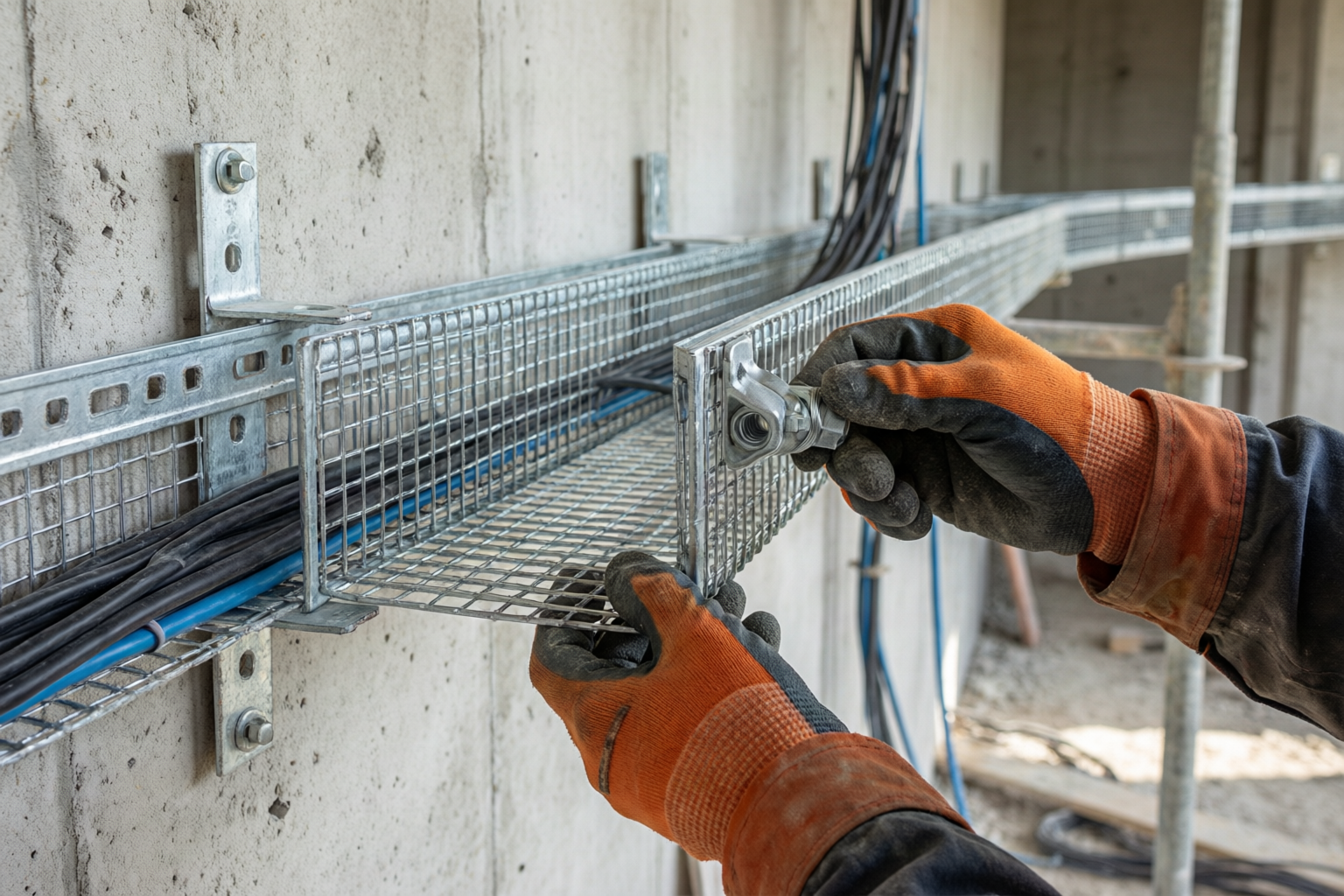
Plan supports, cut cleanly, join correctly, and bond every break so the tray carries its rated load and passes inspection.
Installing Wire Mesh Cable Tray
Plan the route and supports
Mark hanger or bracket positions for the declared load before hanging tray. Follow NEMA VE 2 or project specifications for support spacing and keep joints near supports.
Cut and form the basket
Cut mesh with bolt cutters between transverse wires, deburr every cut end, and bend side wires to form field bends and tees. Fit edge guards where cables enter or exit.
Join lengths with couplers
Connect tray sections with the matched coupler or splice hardware and tighten to the system torque so the joint carries load and electrical continuity.
Bond, ground, and dress cables
Fit bonding jumpers at cuts and expansion gaps where the tray is in the grounding path, then lay cables in a single organized layer within the code fill limit.
Wire Mesh Cable Tray Packing for Export
Packing keeps baskets straight, finishes unmarked, and bundles identifiable through transit and receiving inspection.
Nested and bundled lengths
Straight lengths nest by width and strap into rigid bundles so baskets cannot slide and deform in transit.
Edge and finish protection
Bundle faces and cut ends are wrapped so zinc and powder finishes arrive unmarked and cut edges stay straight.
Pallets and crates
Bundles pack on pallets or in wooden crates to the container plan, with corner protection and steel strapping.
Label by specification
Every bundle carries width, height, wire gauge, finish, length, quantity, and production lot for receiving checks.
Certificates on request
Material certificates, coating thickness reports, and inspection records accompany the shipment when ordered; third-party inspection is available on request.
Wire Mesh Cable Tray in Service
Use scenarios show how width, finish, and accessories change by project; they are not customer claims.

Data center overhead routing
300-600 mm electro-galvanized basket tray on threaded rod trapeze supports, carrying copper and fiber above rack rows with tool-free drop-outs.
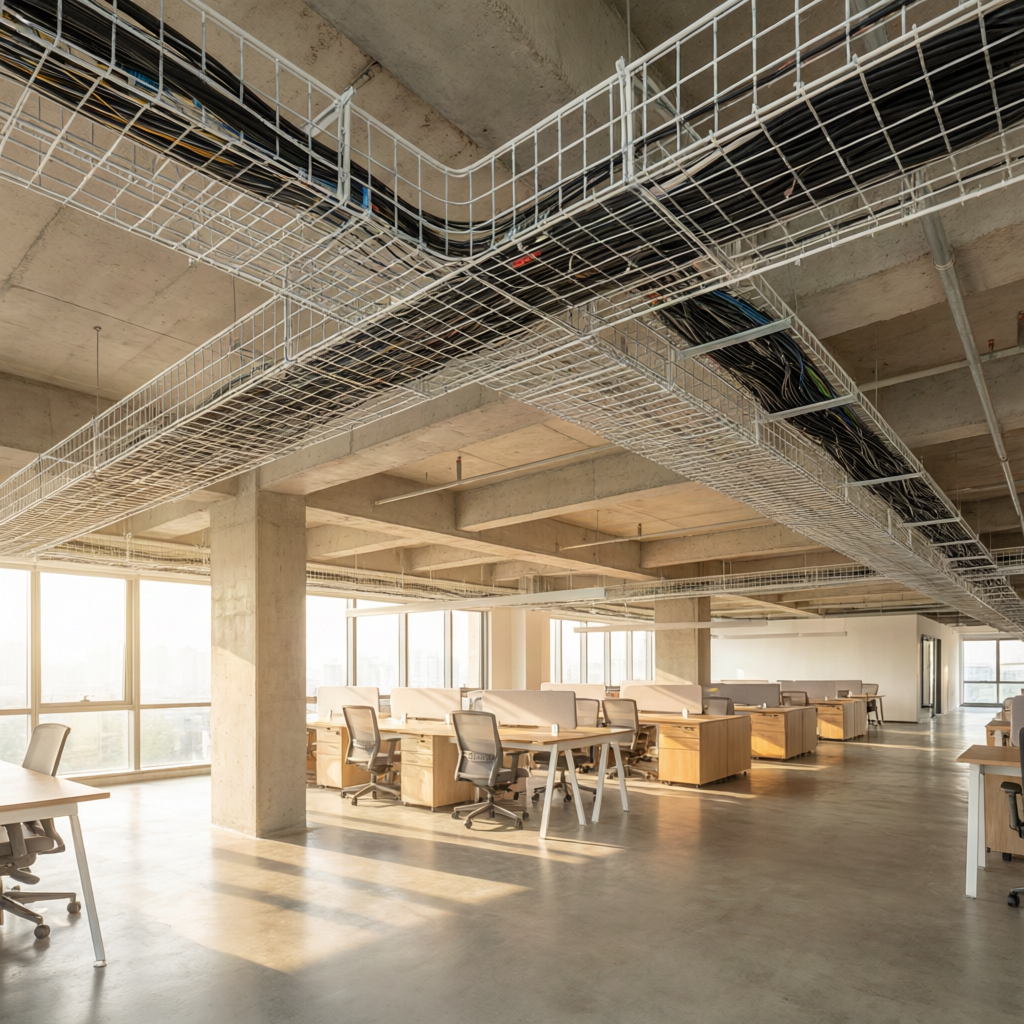
Office building exposed ceiling
Powder-coated mesh tray in the architect's RAL color, routing power and data above open-plan floors as a visible service feature.
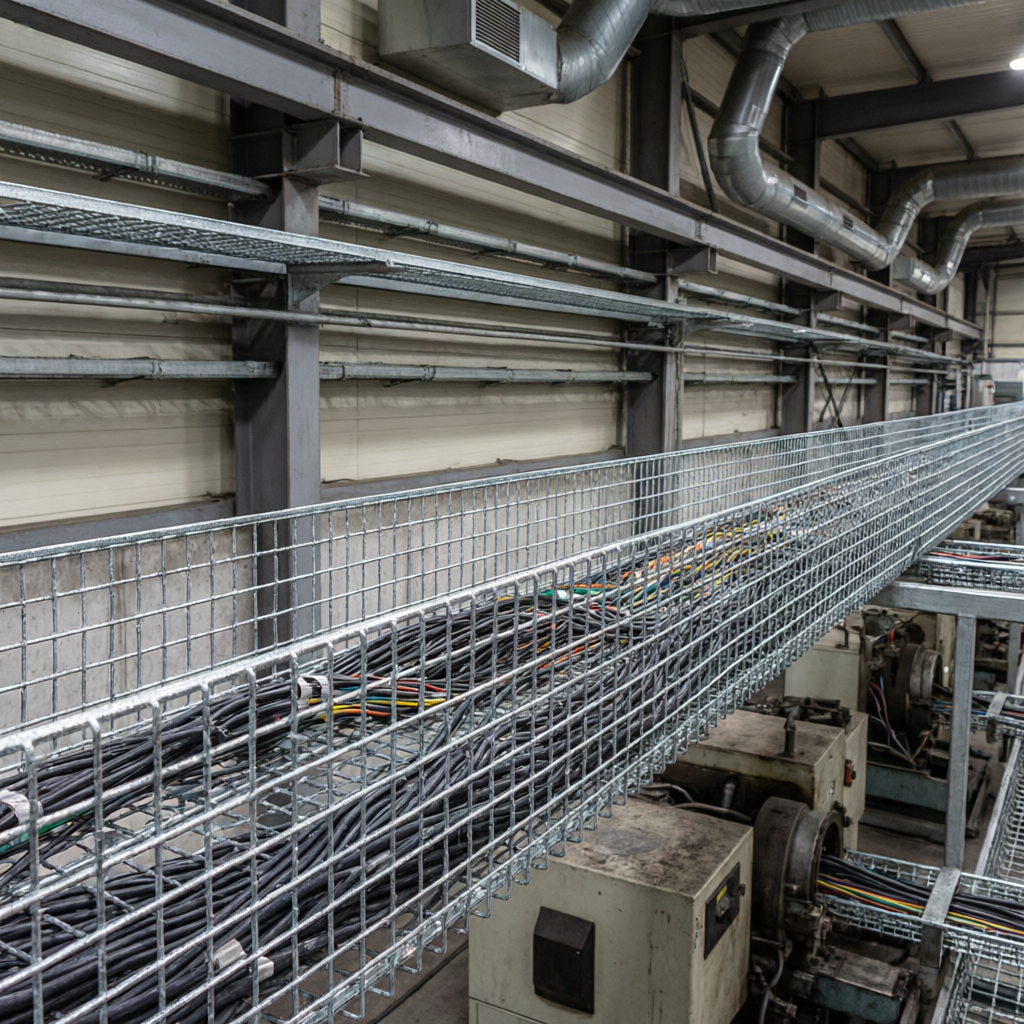
Industrial plant cable distribution
Hot-dip galvanized 400-600 mm tray with 100-150 mm side heights carrying power and control cables along production lines and mezzanines.

Food plant washdown service
304 stainless basket tray with rounded cut edges and stainless hardware, routed through processing halls with regular detergent washdown.
Wire Mesh Cable Tray Sourcing Resources
Compare the welded mesh family behind basket tray, related solutions, and the standards that govern cable tray systems. Confirm the standard edition and project requirements before ordering.
Last updated: 2026-09-01
Related pages
Reference standards
Wire Mesh Cable Tray FAQ
Common procurement questions about basket cable tray sizes, finishes, load capacity, standards, installation, and ordering.
Still have questions about wire mesh cable tray?
Send your tray width, side height, wire gauge, finish, cable load and support span, quantity, and destination. Our sourcing team replies with a specification-led review.
Request a QuoteRequest Wire Mesh Cable Tray Pricing
Send tray width, side height, and length, wire diameter, finish route, cable load and support span, accessory list, quantity, application, and destination for a specification-led sourcing review. Our team replies with matched basket cable tray options and a factory quote.
Your details stay private. We reply with a matched factory quote — no spam.