Copper Wire Mesh: C11000 ETP, C10100 OFHC & C10200 Supplier
Source pure copper wire mesh in C11000 ETP, C10100 OFHC, and C10200 grades. Compare woven, crimped, knitted, and expanded constructions, check mesh counts and purity, and request a factory quote.
View SpecificationsCopper Wire Mesh Grades and Specifications
ASTM B3 defines soft or annealed copper wire composition, while ASTM B152 covers copper sheet and strip used for expanded mesh. CDA alloy designations state the copper grade and oxygen class. State the grade, construction, mesh opening, wire diameter, dimensions, and quantity in every copper wire mesh RFQ.
C11000 ETP, C10100 OFHC, C10200 OF, or C12200 DHP in 99.9%+ copper, verified per ASTM B3
Woven wire cloth, crimped screen, knitted wire mesh, or expanded mesh
Woven cloth from 4 to 400 mesh; crimped screens from 1/4 inch; knitted and expanded mesh in standard stock widths
0.03 mm fine filter wire through 2.5 mm heavy decorative and screen wire
Rolls 1 m or 48 in wide, sheets, discs, and cut-to-size pieces
Bright mill finish standard; lacquered, antique, or brushed finishes on request
Select one or more specifications. Your choices will be included in the quote request.
0 specs selected
| Grade | Copper purity | Oxygen class | Character and RFQ note | |
|---|---|---|---|---|
| C11000 ETP | 99.90% | Oxygen-bearing | The default copper mesh grade: bright, highly conductive, and easy to weave and solder. State the mesh count and wire diameter in the RFQ. | |
| C10100 OFHC | 99.99% | Oxygen-free | Oxygen-free high-conductivity copper for electronics, vacuum, and precision shielding where purity and consistent conductivity matter most. | |
| C10200 OF | 99.95% | Oxygen-free | Oxygen-free copper chosen for brazing and soldering work where hydrogen embrittlement must be avoided. | |
| C12200 DHP | 99.90% | Phosphorus-deoxidized | Deoxidized grade that fabricates and welds more easily, with slightly lower conductivity; useful for formed and fabricated mesh panels. |
Common Stock Specifications: Copper Woven Wire Mesh
Typical stock mesh counts in C11000 wire. Rolls are commonly 1 m or 48 in wide; cut-to-size sheets and discs are available on request. Confirm wire diameter tolerance and grade at RFQ.
| Mesh count | Wire diameter (mm) | Aperture (mm) | Open area | Typical use | |
|---|---|---|---|---|---|
| 20 mesh | 0.35 | 0.92 | 53% | Vent screens, decorative panels, and coarse guards | |
| 40 mesh | 0.25 | 0.385 | 36.8% | EMI shielding panels and general screening | |
| 60 mesh | 0.15 | 0.273 | 42% | Filter backing and RF shielding | |
| 80 mesh | 0.12 | 0.198 | 38.8% | Fine filtration and shielding gaskets | |
| 100 mesh | 0.10 | 0.154 | 37% | Ultra-fine filter cloth and precision screens | |
| 200 mesh | 0.05 | 0.077 | 36.8% | Ultra-fine EMF shielding and micro-filtration |
Copper vs Brass vs Stainless Steel Wire Mesh
The three mainstream choices when you need conductive or decorative mesh. Start from the environment and the duty, then let cost decide between candidates.
| Factor | Copper | Brass | Stainless 304 / 316 | |
|---|---|---|---|---|
| First cost | Highest of the three; tracks copper prices | Medium; tracks copper prices | Low to medium | |
| Electrical conductivity | Excellent; about 100% IACS | Good; about 23-28% IACS by alloy | Poor; about 2-3% IACS | |
| Outdoor and coastal life | Patina forms but metal stays sound | Tarnishes; dezincification risk in seawater | Decades; no coating to fail | |
| Hygiene and antimicrobial | Antimicrobial copper surface | Antimicrobial copper-alloy surface | Cleanable but not antimicrobial | |
| Spark resistance | Spark-resistant | Spark-resistant | Can spark on impact | |
| Appearance | Salmon-pink that darkens to patina | Warm gold that ages to antique tones | Bright metallic that stays clean | |
| Best for | High-conductivity bus and RF work | EMI shielding, décor, filtration, and spark-safe duty | Marine, food, chemical, and architectural duty |
EMI Shielding Mesh Selection Guide
A practical starting point by target frequency and airflow. Shielding performance depends on mesh density, wire diameter, and contact continuity, so verify with samples before bulk production.
| Shielding target | Recommended mesh | Selection note | |
|---|---|---|---|
| Under 100 MHz: general rooms and cabinets | 40 mesh (0.385 mm aperture) | The balanced starting point between shielding and airflow | |
| 100 MHz to 1 GHz | 60-80 mesh | Smaller apertures block more; check that thicker wire does not cut the open area | |
| Above 1 GHz: sensitive electronics | 80-120 mesh, or double layers | Stagger double layers to avoid resonant slot effects at seams | |
| Airflow first: ducts and filter faces | 20-40 mesh | Start at 40 mesh and open up only if the airflow budget fails | |
| Serviceable openings and gasket joints | Knitted copper strip | Flexible knitted mesh keeps continuous contact that foil cannot hold | |
| Ventilation windows on shielded doors | 60 mesh framed panel | Frame the mesh with a conductive gasket; the seam leaks more than the mesh | |
| Test enclosures and lab Faraday cages | 40-80 mesh by band | Seam and door treatment dominate the result; plan a full-enclosure test |
Copper Wire Mesh Weight Chart
Theoretical weight for freight and budget estimates: kg/m2 is roughly 0.36 x mesh count x wire diameter (mm) squared for copper at about 8.96 g/cm3. Actual weight depends on grade, temper, and tolerances; confirm on the packing list.
| Mesh count | Wire diameter (mm) | Weight (kg/m2) | 1 m x 30 m roll (kg) | |
|---|---|---|---|---|
| 20 mesh | 0.35 | 0.88 | 26 | |
| 40 mesh | 0.25 | 0.90 | 27 | |
| 60 mesh | 0.15 | 0.49 | 15 | |
| 80 mesh | 0.12 | 0.41 | 12 | |
| 100 mesh | 0.10 | 0.36 | 11 | |
| 120 mesh | 0.08 | 0.28 | 8 |
Copper Alloy Physical Properties Quick Reference
Typical reference values for annealed copper wire. Actual properties depend on temper, so confirm the certified values with the mill certificate in the RFQ.
| Property | C11000 ETP | C10100 OFHC | C10200 OF | C12200 DHP | |
|---|---|---|---|---|---|
| Density (g/cm3) | ~8.9 | ~8.9 | ~8.9 | ~8.9 | |
| Electrical conductivity (% IACS) | ~101 | ~101.5 | ~101 | ~90 | |
| Tensile strength, annealed (MPa) | ~220 | ~220 | ~220 | ~225 | |
| Elongation, annealed (%) | ~45 | ~45 | ~45 | ~40 | |
| Melting point (deg C) | ~1085 | ~1083 | ~1083 | ~1083 |
Tarnish and Maintenance Guide
Copper does not rust like steel, but it does patina. Match the finish to the environment, and clean with the right chemistry.
| Condition | What happens | How to handle | |
|---|---|---|---|
| Indoor dry décor | Slow darkening to rich bronze and antique tones over months to a year | Accept the aged look, or polish periodically with a copper cleaner | |
| Outdoor without protection | Green verdigris patina develops over months, with water spotting | Choose a lacquered finish if color stability matters, or accept the patina; avoid standing water on the mesh | |
| Frequently touched areas | Fingerprints and faster darkening on contact zones | Specify clear lacquer, or plan regular wipe-downs | |
| Damp or rain-exposed service | Green patina may develop on the surface | Prevent trapped moisture; upgrade to coated or stainless mesh if aesthetics matter | |
| After welding or cutting | Heat tint and discolored zones near the work area | Polish locally or re-finish the panel; prefer soldering for fine cloth | |
| Cleaning | Harsh chemistry can etch fine wire | Mild soap and water with a soft cloth; commercial copper cleaner; never ammonia-based or strong-acid cleaners |
Mesh Count to Aperture Conversion
One formula removes all mesh-count ambiguity: aperture (mm) = 25.4 / mesh count - wire diameter (mm). Cross-check the result with the stock table above before you write the RFQ.
| Mesh count | Wire diameter (mm) | Aperture (mm) | Aperture (in) | |
|---|---|---|---|---|
| 20 mesh | 0.35 | 0.92 | 0.036 | |
| 40 mesh | 0.25 | 0.385 | 0.015 | |
| 60 mesh | 0.15 | 0.273 | 0.011 | |
| 80 mesh | 0.12 | 0.198 | 0.008 | |
| 100 mesh | 0.10 | 0.154 | 0.006 | |
| 120 mesh | 0.08 | 0.132 | 0.005 |
Copper Wire Mesh Standards Quick Reference
Match the standard to the product form: wire before weaving, or sheet before expanding. Confirm the standard edition, grade, and temper in the purchase order.
| Standard | Scope | RFQ note | |
|---|---|---|---|
| ASTM B3 | Soft or annealed copper wire specification | The default wire standard for copper wire mesh; state grade and purity | |
| ASTM B152 | Copper sheet, strip, plate, and rolled bar | Applies to expanded copper mesh produced from sheet | |
| EN 1652 | European copper and copper alloy plate, sheet, strip | State the European grade alongside the CDA number for EU buyers | |
| CDA alloy designations | Copper Development Association numbering for copper and copper alloys | Use CDA numbers such as C11000 or C10100 to avoid trade-name ambiguity |
Constructions We Source in Copper
One material, many constructions. Compare woven, crimped, knitted, and expanded copper wire mesh before you specify.
Copper woven wire mesh
Plain, twill, and Dutch weave cloth from 4 to 400 mesh for shielding, filtration, and screens.
Copper crimped wire mesh
Pre-crimped heavier wire locks openings for decorative panels and guards that keep their shape.
Copper knitted wire mesh
Knitted copper wire mesh strips for RF gaskets, pipe wraps, and mist eliminators that flex with the joint.
Copper expanded mesh
Slit-and-stretched sheet forms rigid, slip-resistant copper mesh for guards, treads, and decorative cladding.
Where Copper Wire Mesh Is Used
Choose copper wire mesh when you need the highest conductivity of the common mesh metals, a naturally antimicrobial surface, and a distinctive warm-red look in one product.
EMI and RF shielding
Copper woven mesh lines Faraday cages, equipment cabinets, and RF gaskets, blocking electromagnetic interference with the best conductivity-to-cost balance among common metals.
MRI and laboratory shielding
Copper mesh builds the shielded rooms that keep RF out of MRI suites, electronics labs, and test enclosures where brass or stainless would underperform.
Filtration and sieving
Fine copper woven cloth filters liquids and gases, sieves powders, and backs coarser media where conductivity and contamination-free surfaces matter.
Architectural and decorative
The salmon-pink copper tone dresses facades, room dividers, lighting fixtures, and fireplace screens with a warm metallic look that ages to patina.
Pest and rodent control
Copper wire netting blocks rodents, snails, and insects without rusting, and the antimicrobial surface adds value in food-adjacent spaces.
Heat transfer and HVAC
Copper's high thermal conductivity suits heat exchanger screens, HVAC grids, and ventilation assemblies that double as conductive paths.
Marine and aquaculture
Copper resists biofouling and algae growth, making copper mesh a practical choice for aquaculture enclosures and splash-zone screening.
Craft, art, and jewelry
Fine copper mesh for wire art, sculptures, inlays, and artisan jewelry that buyers recognize by the unmistakable warm-red copper tone.
How to Select the Right Copper Wire Mesh
Start from the duty, then fix grade, construction, opening, and verification. A complete RFQ avoids assumptions and re-quotes.
By duty, not by looks
EMI shielding and fine filtration need dense woven cloth in C11000. Decorative panels can use crimped, knitted, or expanded mesh in any copper grade.
Which grade?
C11000 ETP is the versatile default. C10100 OFHC or C10200 OF serve electronics and vacuum duty. C12200 DHP fabricates and welds more easily for formed panels.
By construction
Woven copper wire mesh gives the finest openings and true shielding performance. Crimped mesh keeps heavy openings stable. Knitted mesh flexes. Expanded mesh is rigid and slip-resistant.
By opening and wire diameter
Define what the mesh must keep in or out, then set opening and wire diameter together. State both in millimeters to avoid mesh-count ambiguity.
Shielding vs airflow
Denser mesh blocks more EMI but chokes airflow and light. For cabinets and vents, balance mesh count against cooling requirements and test the finished assembly.
Temper and formability
Copper is used mostly annealed or half-hard, forming and soldering easily. State the temper for any part that must hold a shape under load.
Finish and aging
Bright copper patinas over time. Specify lacquered, antique, or brushed finish when color stability matters in décor.
Verify the grade
State the CDA grade number in the RFQ and request a mill certificate confirming purity. Visual color alone cannot distinguish ETP from OFHC copper.
Copper Wire Mesh Buying Mistakes to Avoid
Six errors that shorten service life or trigger disputes. Each one is avoidable at the RFQ stage.
Paying for copper where brass does the job
Copper costs more than brass and tracks the copper market closely. If you only need moderate conductivity and spark resistance, brass wire mesh delivers most of the value at lower cost.
Choosing copper for structural or abrasive duty
Copper is soft and ductile. For heavy loads, high abrasion, or long structural life, stainless steel or galvanized mesh usually wins.
Skipping the oxygen class for sensitive duty
Electronics, vacuum, and brazing applications can require oxygen-free C10100 or C10200. C11000 ETP is not the right grade for every job.
Using coarse mesh where shielding is the goal
Open mesh may look like a shield but pass the frequencies you need to block. Define the target frequency band and verify with the supplier.
Mixing copper with steel in wet contact
Dissimilar-metal contact corrodes the copper and stains the steel. Separate copper mesh from steel fasteners and frames in outdoor or humid duty.
Expecting a finish that never changes
Bright copper patinas naturally. If color stability matters, specify a lacquered finish instead of accepting field aging.
Why Buyers Choose Copper Wire Mesh
Copper wire mesh is the best-conducting, naturally antimicrobial member of the metal mesh family: real engineering duty with a signature warm-red look.
Highest conductivity
Copper carries about 100% IACS, the best of the common mesh metals, letting one mesh serve as screen, guard, and grounding or shielding element at once.
Antimicrobial surface
Copper surfaces are recognized as antimicrobial, a useful property in food, retail, healthcare, and marine screening and décor.
Spark-resistant safety
Copper does not strike impact sparks, making copper wire mesh a safe choice in explosive atmospheres, oil depots, and grain plants.
Self-protecting patina
Copper forms a protective oxide layer instead of rusting, so the metal stays sound outdoors while the surface ages to a characteristic tone.
Easy to form and solder
Copper wire cuts, bends, and solders cleanly, so panels, gaskets, and custom shapes fabricate without special tooling.
Recyclable and traceable
Copper scrap retains strong value, and mill certificates per ASTM B3 confirm grade and purity for every production lot.
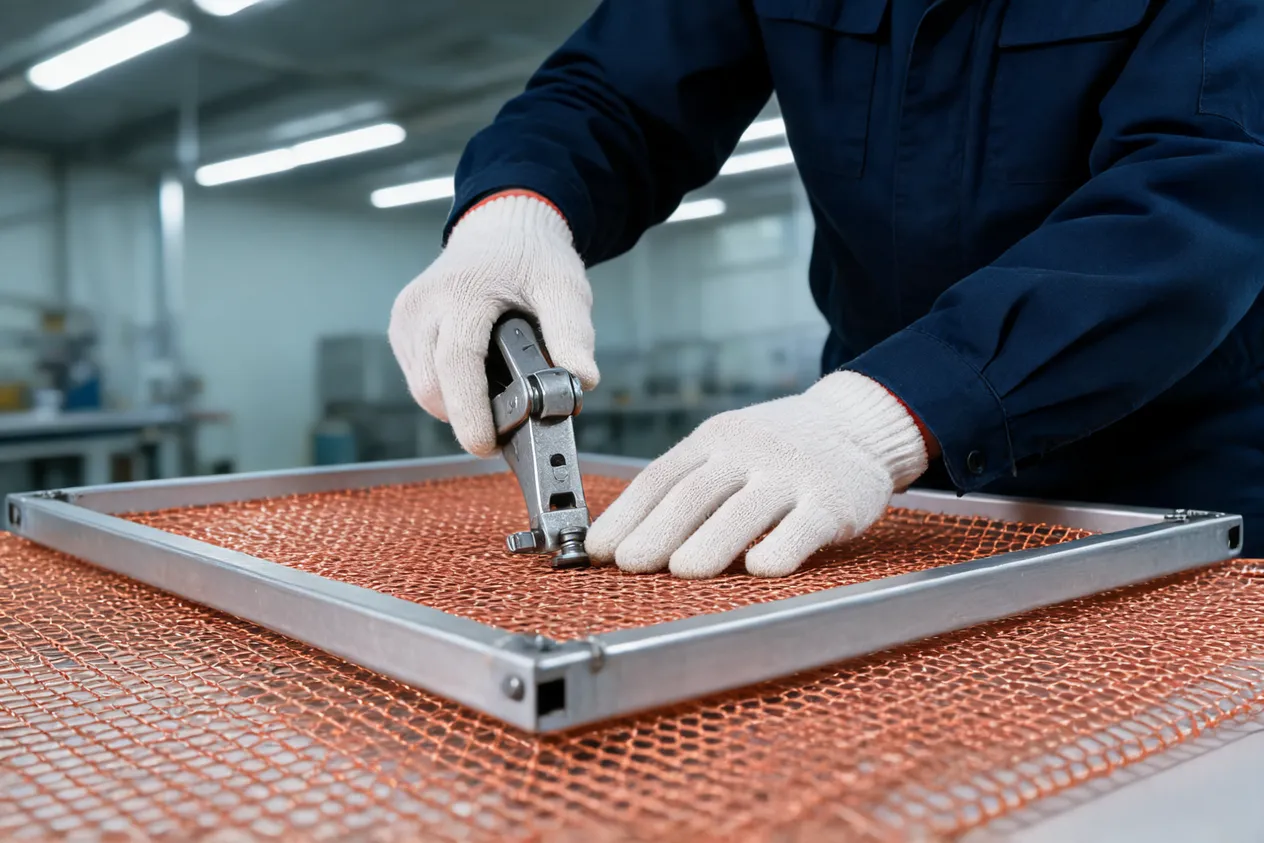
Protect the surface and the temper. Cut cleanly, solder or clamp rather than weld, and clean with the right chemistry.
Working with Copper Wire Mesh
Cut along the wire line
Cut woven copper cloth along a wire and crimped mesh between crimps, using shears or a fine-tooth blade. Deburr edges so loose wire ends cannot catch or tear.
Fasten with solder, rivets, or clamps
Copper solders and brazes cleanly with lead-free silver solder. Rivets and formed clamps suit heavier mesh. Avoid oxy-fuel welding on fine cloth, which anneals and distorts it.
Keep it isolated from steel
In humid or outdoor service, separate copper mesh from steel frames and fasteners with paint, tape, or non-metallic washers to prevent galvanic staining.
Clean without harsh chemistry
Wash with mild soap and water, or a commercial copper cleaner for patina. Avoid ammonia-based cleaners, which attack copper and leave etching marks on fine wire.
Copper Wire Mesh Packing for Export
Packing protects fine wire from crushing, keeps surfaces from scratching, and preserves traceability through transit and receiving inspection.
Rolls on cores, wrapped
Fine woven rolls wind on cores, wrapped in kraft and waterproof film with protected edges to prevent kinking.
Flat packs for panels
Rigid panels pack flat with interleaving paper and edge protection, strapped on pallets or in plywood cases.
Label by grade and mesh
Each bundle carries grade, mesh count, wire diameter, dimensions, quantity, and finish.
Mill certificates
Composition certificates per ASTM B3 accompany the shipment when requested, confirming grade and purity.
Share destination details
State destination port, trade term, container plan, and inspection requirements. Pre-shipment inspection by SGS, BV, or TÜV is available on request.
Copper Wire Mesh in Service
Use scenarios show how grade and construction change by duty; they are not customer claims.
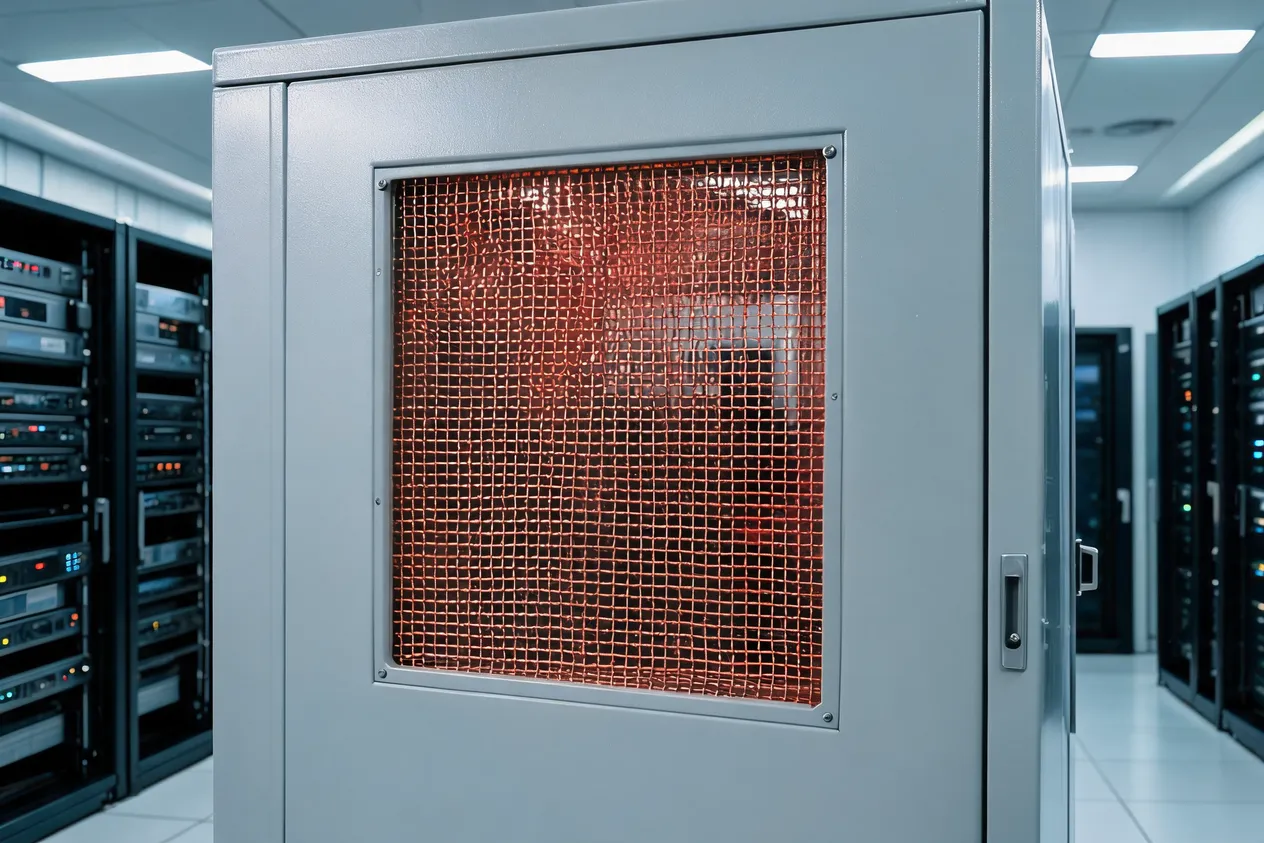
EMI shielding enclosure
C11000 woven copper cloth fitted to a shielded enclosure frame, sized for the target frequency band and verified before release.
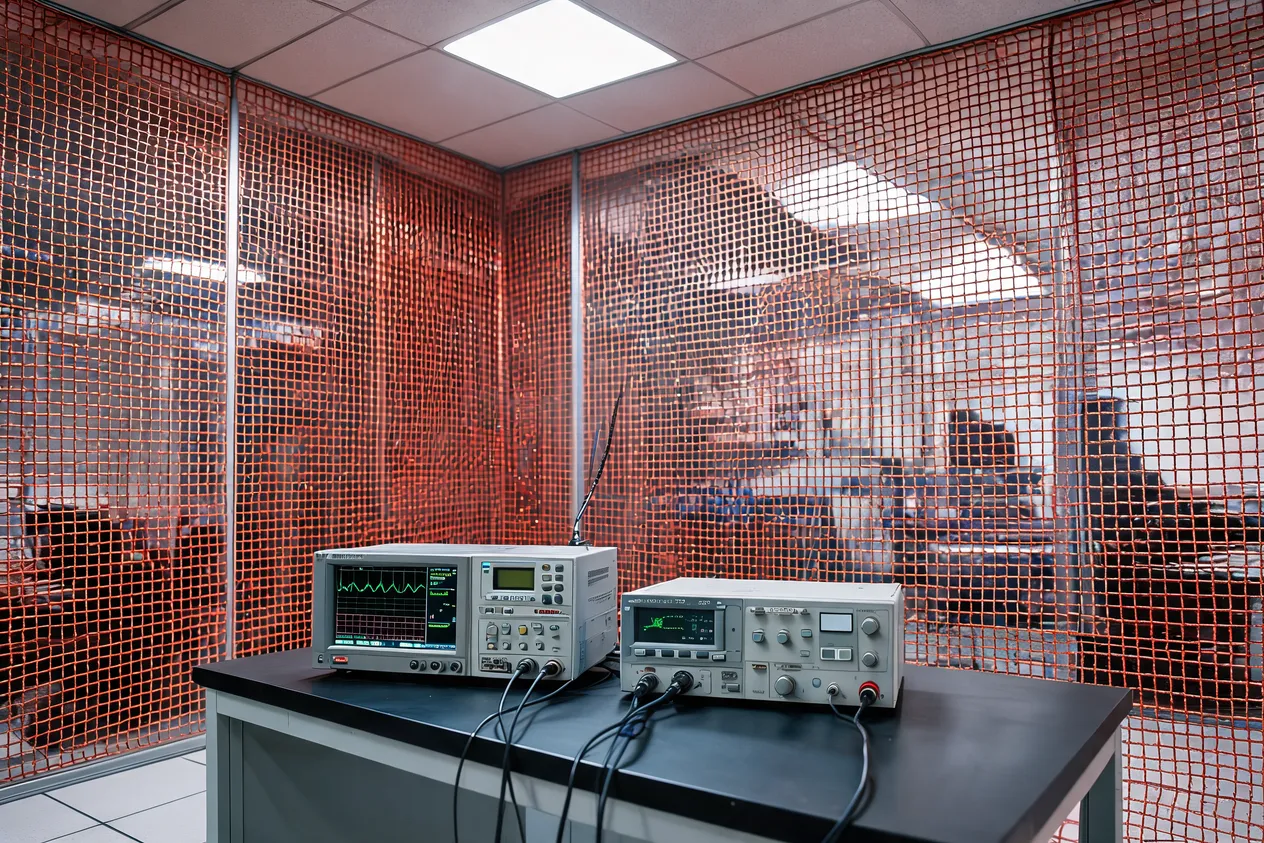
Shielded laboratory room
Copper mesh-lined walls and windows for an electronics or MRI-adjacent lab, where seams and door treatment dominate the result.
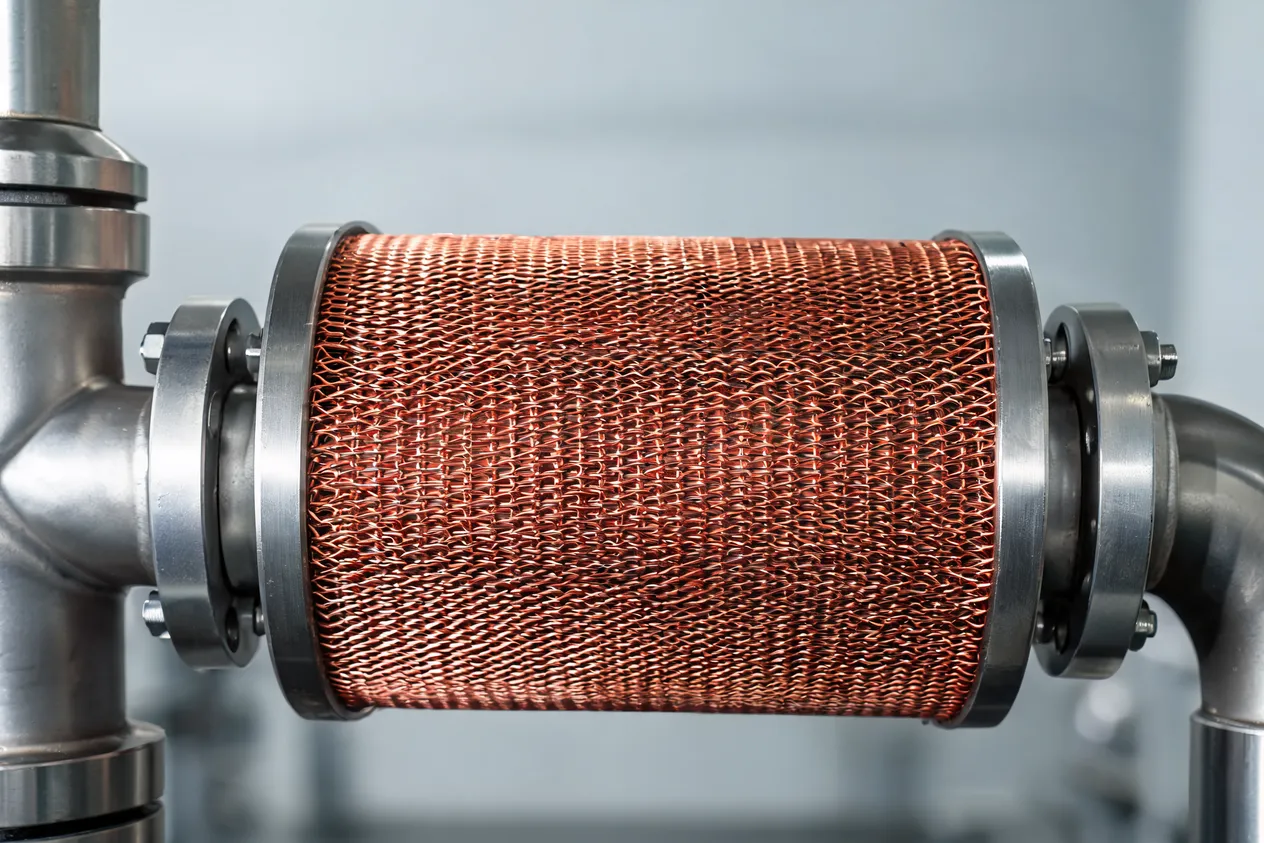
Fine filtration duty
C11000 woven cloth at 80 and 100 mesh supplied for a liquid filtration line where conductivity and contamination-free surfaces mattered.

Architectural feature panel
Copper mesh panels installed as a lobby divider or facade feature, combining open sightlines with the signature warm-red copper tone.
Copper Wire Mesh Sourcing Resources
Compare grades and constructions, and confirm the standard edition before ordering.
Last updated: 2026-09-04
Related pages
Copper Wire Mesh FAQ
Common procurement questions about grades, constructions, and ordering copper wire mesh.
Still have questions about copper wire mesh?
Send your grade, construction, mesh count, wire diameter, finish, and quantity. Our sourcing team replies with a specification-led review.
Request a QuoteRequest Copper Wire Mesh Pricing
Send grade, construction, mesh count, wire diameter, temper, finish, dimensions, quantity, application, and destination for a specification-led sourcing review. Our team replies with matched copper wire mesh options and a factory quote.
Your details stay private. We reply with a matched factory quote — no spam.