Perforated Stainless Steel Sheet: Specs & Sourcing
Compare perforated stainless steel sheet grades, hole patterns, thickness, pitch and open area. Send dimensions, quantity and drawings for a sourcing quote.
View SpecificationsSpecify the Material and the Perforation Separately
Perforated stainless steel sheet is a solid stainless sheet with a defined pattern of holes. It differs from interlaced wire cloth and slit-and-stretched expanded metal. Use the grade comparison as selection guidance, then specify the hole layout and finished sheet requirements; the tables are not a stock list or a guaranteed supply range.
State 304, 304L, 316 or 316L and the required material standard and edition.
Round diameter, square side, or slot width and overall length, with units.
Center-to-center spacing, row arrangement and perforation direction.
Give thickness in mm or inches, plus the gauge system if a gauge number is used.
Width, length, quantity, solid margins, surface finish and dimensional tolerances.
Select one or more specifications. Your choices will be included in the quote request.
0 specs selected
| Grade | Material distinction | Selection consideration | RFQ confirmation | |
|---|---|---|---|---|
| 304 | Austenitic chromium-nickel stainless steel. | Evaluate for general service after reviewing moisture, chemicals and cleaning exposure. | Required material designation, base-sheet standard, finish and acceptance records. | |
| 304L | Low-carbon alternative to 304. | Lower carbon reduces carbide precipitation during welding; assess the finished fabrication route. | State the low-carbon grade explicitly and identify welding and post-fabrication requirements. | |
| 316 | Molybdenum-alloyed austenitic stainless steel. | Compare with 304 where increased corrosion resistance is required; it is not immune to chloride attack. | Describe chloride concentration, temperature, exposure duration and cleaning conditions. | |
| 316L | Low-carbon alternative in the 316 family. | Combines molybdenum alloying with reduced sensitivity to intergranular corrosion after welding. | Confirm grade, welding route, finish and agreed material documentation before order release. |
Open Area Calculation Examples — Not Stock Specifications
For round holes, d is hole diameter and p is center-to-center pitch, both in the same unit. Direct Metals gives open area (%) = 90.69 × (d / p)² for a 60° staggered pattern and 78.54 × (d / p)² for straight rows with equal pitch in both directions. These theoretical percentages describe the perforated field; solid margins, frames and backing affect the complete sheet or assembly. Selecting an example for an inquiry does not establish manufacturing feasibility or availability.
| Example layout | Hole diameter d | Pitch p | Calculated open area | Meaning | |
|---|---|---|---|---|---|
| 60° staggered round holes — geometry example | 3 mm | 5 mm | 32.65% | 90.69 × (3 / 5)²; perforated field only. | |
| Straight round holes, equal pitch — geometry example | 3 mm | 5 mm in both directions | 28.27% | 78.54 × (3 / 5)²; perforated field only. |
Four Patterns to Define in Your Drawing
Hole shape and arrangement are separate specification fields. Confirm feasibility for the requested grade, thickness, hole size, pitch and sheet dimensions rather than assuming every combination can be punched.
60° staggered round holes
Specify hole diameter and the nearest center-to-center pitch on a triangular grid. This layout has a different open-area formula from straight rows; identify the pattern orientation and solid margins.
Straight-row round holes
Specify diameter and pitch in both directions. Use the equal-pitch formula only for a square grid; rectangular spacing needs a calculation based on both center distances.
Square holes
State the clear side dimension, row arrangement and pitch in each direction. Confirm corner geometry, edge condition and alignment with the finished sheet outline.
Slotted holes
Give slot width, overall length, end shape, orientation and both pitches. Slotted stainless sheet needs its own drawing and geometry calculation; round-hole formulas do not apply.
Match the Sheet to the Finished Assembly
The following uses help identify specification questions. They are illustrative applications, not completed customer projects, product approvals or performance guarantees.
Ventilation covers
Define the airflow objective, opening geometry, sheet dimensions and mounting arrangement. Open area alone does not establish the pressure drop of a finished cover.
Acoustic panel facings
Specify the facing pattern together with the backing material and cavity. The complete assembly determines acoustic performance; a perforation percentage is not an acoustic rating.
Process screens
Describe the material being separated, particle shape and size, throughput and cleaning method. Hole size and pattern are inputs to process selection, not a guaranteed separation result.
Architectural screens
Coordinate pattern orientation, margins, finish and panel joints with the project drawing. Fixing and structural requirements belong to the finished assembly design.
Equipment enclosures
Provide opening restrictions, access requirements, fixing details and the equipment designer's approved requirements. A sheet photograph cannot establish guarding suitability.
Fabricated baskets and liners
Define the part shape, joining route and service environment. For direct food contact, state the applicable material, finish and compliance requirements rather than relying on the grade name alone.
How to Select Perforated Stainless Steel Sheet
WireMesh Sourcing coordinates specification-led factory matching, quality control and export requirements. A complete brief helps separate the material requirement, perforation geometry and fabrication scope before suppliers quote.
Describe service and cleaning exposure
List moisture, chlorides, chemicals, temperature, cleaning agents and whether deposits or crevices can develop. Outokumpu's corrosion guidance explains why grade selection depends on the full environment; 316 is not universally rust proof.
Define the aperture and its layout
Name the hole shape, clear dimensions, center pitches and row arrangement. Add the perforation direction and any non-perforated zones to the drawing.
Choose thickness with the part design
State actual thickness and tolerances, supported span, loads, folds and frame details. Confirm the hole-to-thickness combination with the perforator; no universal ratio establishes feasibility for every tool and material.
Specify edges and appearance
Identify solid margins, cut-through edges, burr direction, deburring requirements and the required surface finish. If a visible finish matters, define an agreed reference sample and inspection method.
Agree inspection and documents
Request the required material records and agree checks for hole dimensions, pitch, thickness, sheet size, margins, flatness and finish. ASTM A240/A240M is a base-material reference, not a complete finished-perforation acceptance specification.
Provide quantity and delivery inputs
Send piece count, dimensions, drawing revision, sample requirements, packing preference, destination and required date. Availability, MOQ, tooling, price and schedule are confirmed against the actual request.
Avoid Ambiguous Perforated Sheet Specifications
Resolve these differences before comparing quotes or approving production.
Treating hole size as pitch
Diameter is the opening across a round hole; pitch is the distance between hole centers. For 3 mm holes on 5 mm centers, the nearest ligament is 2 mm, not 5 mm. Identify each dimension on the drawing.
Using one open-area formula for every pattern
A 60° staggered grid and an equal-pitch straight grid have different repeating areas. Name the pattern before calculating; slotted and unequal-pitch layouts need their own geometry.
Ordering by gauge without a thickness
Gauge depends on the material and numbering system. Give the applicable system and actual thickness in mm or inches, with an agreed tolerance.
Leaving margins and burr direction undefined
A solid border changes the usable perforated field, while the punched burr side can affect handling and assembly. Specify all margins, edge treatment and the required orientation of each face.
Assuming a grade name proves suitability
304 or 316 identifies a material family, not a finished product's corrosion immunity, food-contact approval, acoustic rating or load capacity. Define application requirements and their acceptance evidence separately.
What a Defined Perforated Sheet Can Offer
Evaluate these attributes against the required assembly and environment. They explain the construction and procurement approach without implying tested performance for an unspecified sheet.
Defined opening geometry
Hole size, shape and arrangement can be described explicitly, making supplier quotations and dimensional inspection easier to compare.
Material choice for the exposure
Separate the alloy decision from the hole pattern so corrosion and fabrication requirements receive their own review.
A sheet-based part definition
A drawing can combine perforated fields, solid margins and finished dimensions. Cutting, bending and joining requirements are confirmed for the actual part.
Clear quality-control checkpoints
Agreed checks for material records, geometry, edges and appearance provide a common acceptance basis before dispatch.
Comparable quotation inputs
One specification covering quantity, tooling, finish, inspection and packing helps identify differences between offers rather than comparing unit prices in isolation.
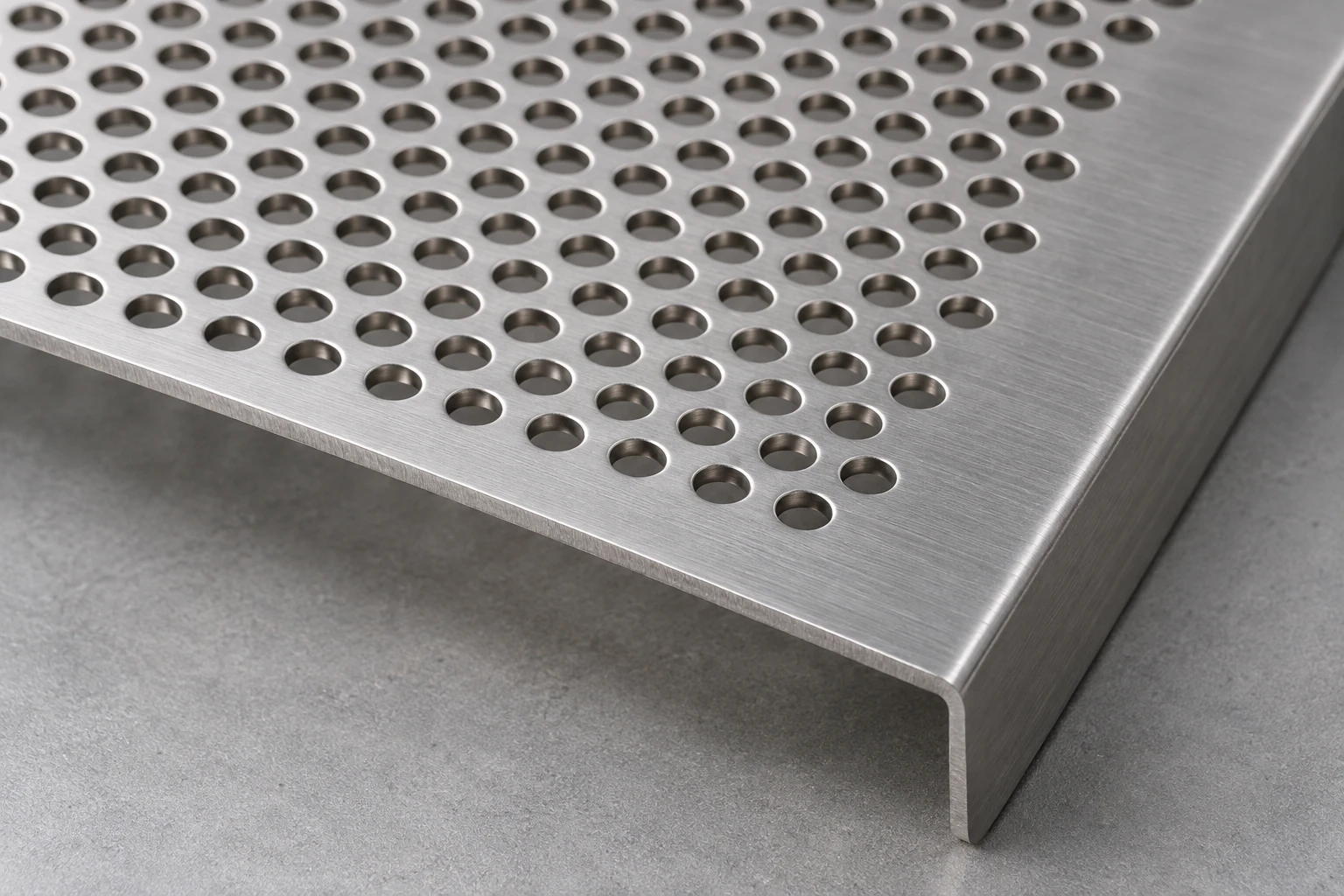
Illustrative perforated-sheet construction. The image does not establish material grade, dimensions or installation approval.
Confirm the Finished Part Before Order Release
Approve the drawing revision
Confirm sheet outline, hole layout, unperforated margins, cutouts and mounting details. Identify the drawing revision used for quotation and acceptance.
Review cutting and forming
Describe cut edges, folds, bend locations and pattern direction. Ask the fabricator to confirm tooling feasibility and agreed flatness after processing.
Define joining and surface requirements
Specify frame material, connection details, burr treatment and any post-fabrication cleaning or surface treatment. Keep finished-part requirements separate from the incoming base-sheet finish.
Check fit and acceptance
Agree the sample or drawing approval route and receiving checks. Assembly loads, fixing suitability and application performance require review against the project design.
Define Protection and Traceability for Shipment
Agree the packing method for the sheet dimensions, finish, quantity and transport route. These are requirements to confirm in the quotation, not a fixed packing promise.
Protect faces and edges
Specify suitable interleaving, face protection and edge protection where needed. Confirm whether temporary film is required and how it will be removed after receipt.
Support the sheet bundle
Agree pallet or crate support, restraint and lifting access for the actual sheet size. Packing should address distortion and movement during the planned transport route.
Separate and label specifications
Keep grades, thicknesses, patterns and drawing revisions identifiable. Define the bundle marks and any material-record references required for receiving inspection.
Confirm destination requirements
Provide delivery location, unloading constraints and any applicable packaging requirements. Agree moisture protection and document handling before dispatch.
Four Example Specification Briefs
These images and scenarios illustrate possible uses of perforated sheet. They are not customer case studies and do not verify stainless grade, supplied dimensions or project results.
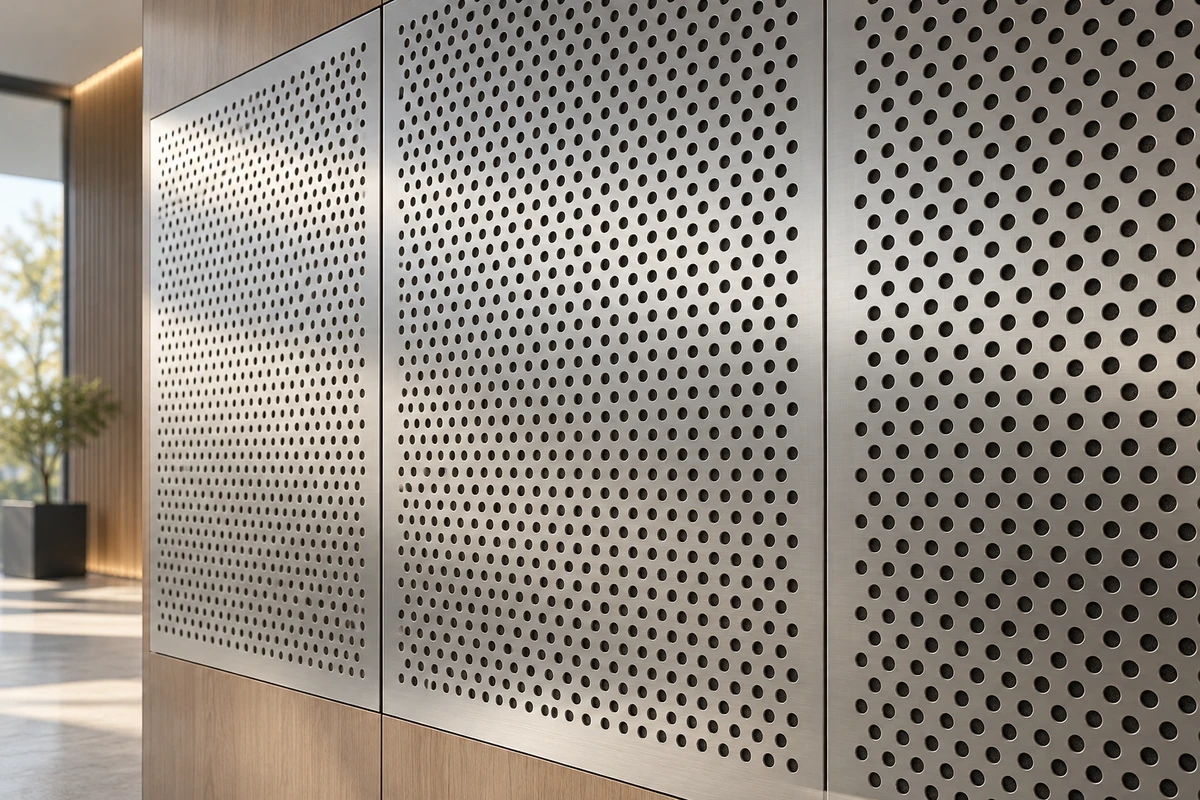
Acoustic panel facing example
Define the perforation layout, facing finish, backing and cavity, then verify the acoustic performance of the complete assembly.
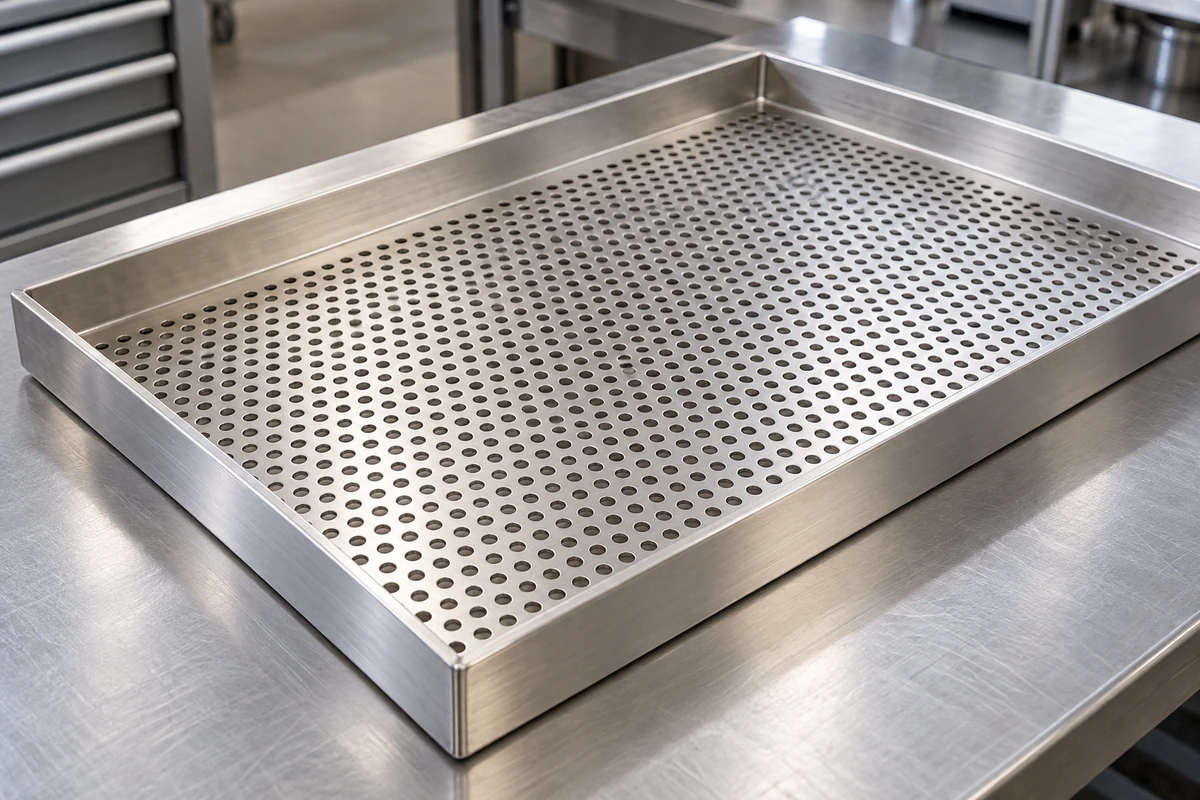
Process screening example
Match hole geometry to the material being handled and define cleaning access, edge treatment and a process acceptance method.
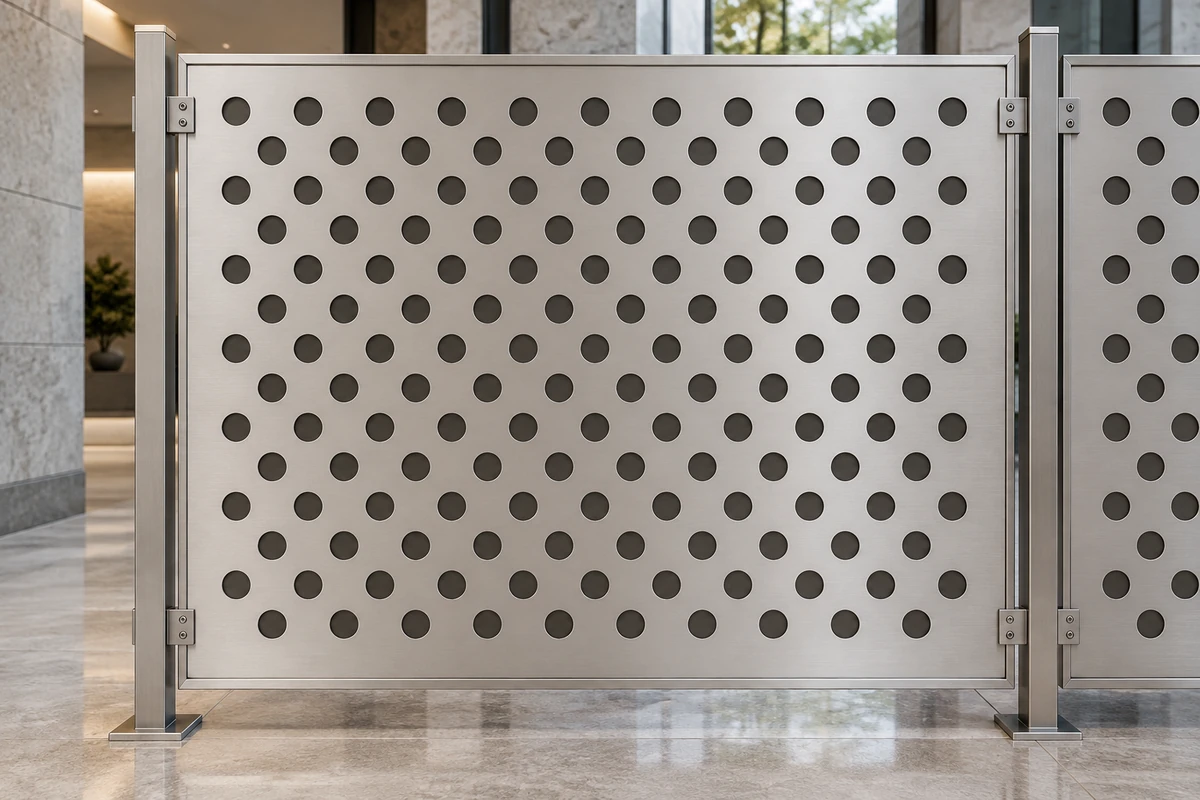
Architectural screen example
Coordinate the visible pattern, solid borders, panel joints and mounting details with an approved architectural drawing.
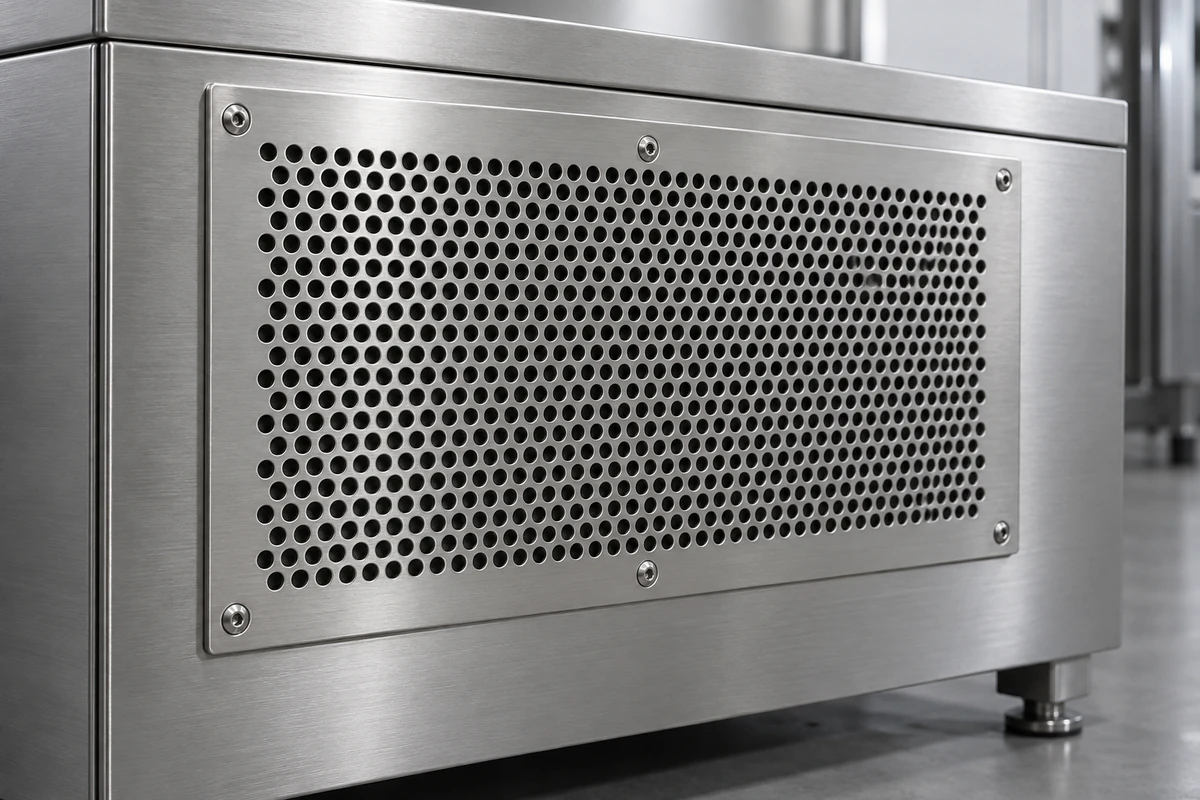
Ventilation cover example
Specify the opening layout, finished cover dimensions and attachments; confirm airflow and equipment requirements for the assembly.
Perforated Stainless Steel Sheet References
Outokumpu supports the alloy and corrosion explanations; Direct Metals supports the geometry formulas; ASTM defines the scope of the base-sheet standard. These references do not establish our stock, certify an order or replace agreed finished-sheet acceptance requirements.
Last updated: 2026-10-12
Related sourcing pages
Technical evidence
Perforated Stainless Steel Sheet FAQ
Direct answers to common specification and procurement questions before submitting an RFQ.
Have a drawing or an incomplete specification?
Send the known grade, hole layout, thickness, dimensions and quantity, and identify the fields that still need confirmation.
Request a QuoteRequest a Perforated Stainless Steel Sheet Quote
Send grade, hole shape and dimensions, pitch and layout, sheet thickness, finished width and length, margins, finish, quantity, destination and drawing revision. Add inspection, material-document and packing requirements so the sourcing review follows your actual specification.
Your details stay private. We reply with a matched factory quote — no spam.