Copper wire
- What to specify
- Material grade and wire condition
- Include in your RFQ
- Required designation and applicable material standard
- Agree before ordering
- Offered grade, condition and supporting material records
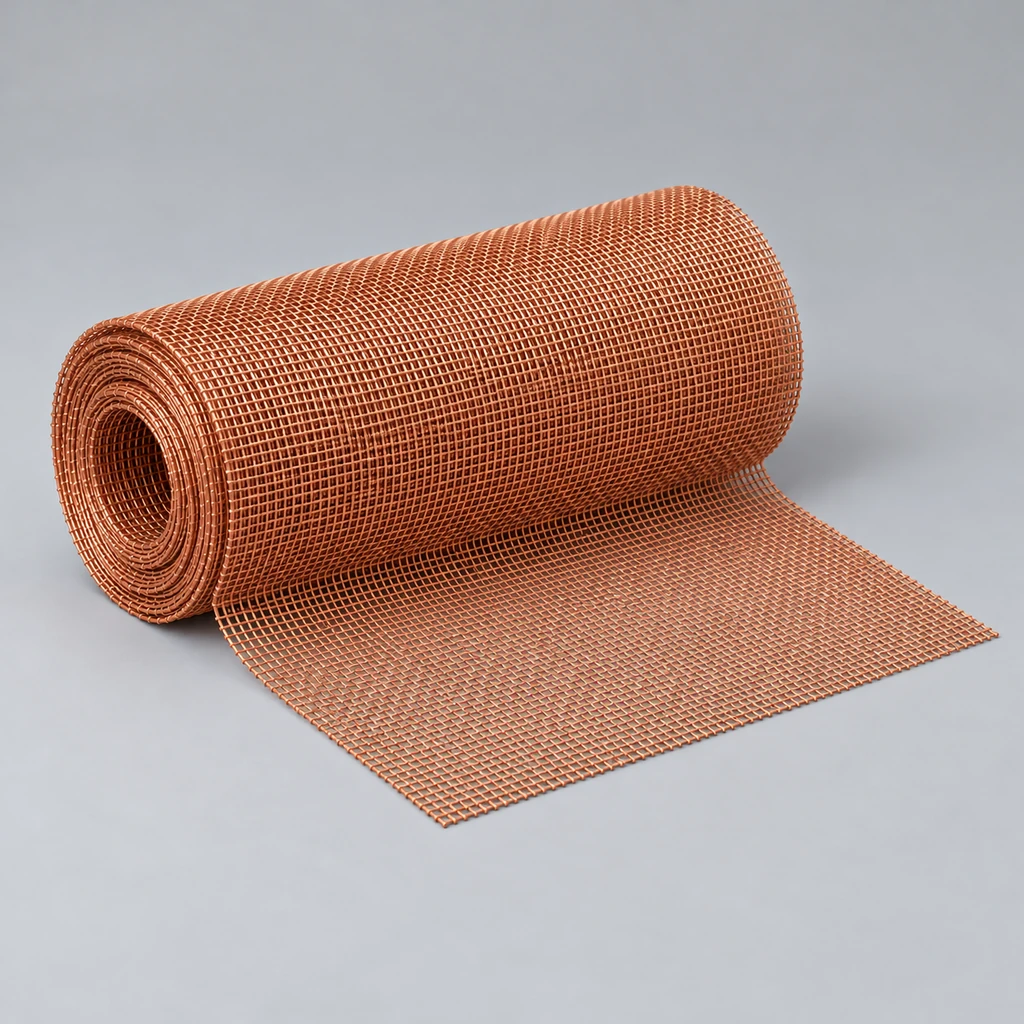
Red copper woven mesh is pure copper wire cloth for electronic shielding and conductive screening assemblies. Compare mesh geometry, review the enclosure connections and plan sample checks before ordering. Use the specifications and buying guide below to define the copper grade, finished dimensions and acceptance requirements for your application.
FOB reference price from $32.00 / m². Varies by spec and quantity; final quote on inquiry.
Catalog specificationsMesh Count
40–80
Wire Diameter
0.12–0.25 mm
Clear Aperture
0.198–0.385 mm
Open Area
36.8–38.8%
Material Family
Red Copper
Catalog Specs
2
Sample
Available
Specify red copper woven mesh for the electrical function and installation it must serve. An RF enclosure window needs both a mesh opening and a frame interface. A conductive joint also needs its contact movement and compression duty defined. Flat woven cloth and a formed gasket require separate construction and fit reviews.
Select specifications to include in your inquiry.
| Nominal Mesh Count | Std. Wire Dia. (mm)Std. Wire Dia. (inch / Gauge) | Aperture Size (mm)Aperture Size (inch) | Ref. Open Area | Est. Weight (kg/m²)Est. Weight (lb/ft²) | |
|---|---|---|---|---|---|
| 40 Mesh | 0.250 mm0.00980" | 0.385 mm0.01520" | 36.8% | 1.25 kg/m²0.2600 lb/sq.ft | |
| 80 Mesh | 0.120 mm0.00470" | 0.198 mm0.00780" | 38.8% | 0.58 kg/m²0.1200 lb/sq.ft |
These red copper woven mesh examples use the mesh count and wire diameter of each current catalog SKU to calculate nominal square-weave openings. Compare the result with the catalog aperture and open area instead of choosing by mesh count alone.
| Mesh per inch | Wire diameter (mm) | Calculated opening (mm) | Calculated opening (μm) |
|---|---|---|---|
| 40 | 0.25 | 25.4 ÷ 40 − 0.25 ≈ 0.3850 mm | 385.0 |
| 80 | 0.12 | 25.4 ÷ 80 − 0.12 ≈ 0.1975 mm | 197.5 |
The calculation displays four decimal places in millimetres and one in micrometres; the catalog aperture is rounded separately. A higher mesh count does not necessarily mean less open area when the wire diameter also changes. Read open area from the specification table. Calculated geometry does not establish shielding attenuation, an absolute filtration rating or airflow capacity.
Download the Full Wire Mesh Catalog
Reference specifications and applications in the catalog; confirm order-specific requirements with your RFQ.
Start with the problem your red copper woven mesh must address. Use the calculated opening examples to compare geometry, the troubleshooting table to review an underperforming assembly, and the sample sequence to turn a selected mesh into an agreed purchasing specification.
Check the copper cloth in the form and assembly you intend to purchase. A dimensional check confirms the cloth geometry; it does not replace a performance evaluation of the finished enclosure or conductive joint.
Record the application, frequency range, required result and test conditions. Agree how a sample will be accepted before comparing materials or quotations.
Match the agreed copper grade and available material records to the sample. Verify wire diameter, clear opening, finished dimensions and edge condition against the purchasing requirements.
Install the mesh in the intended frame or fixture. Check support, edge handling, fixation and the contact interface; record any adjustments needed to obtain the intended fit.
Compare results under consistent conditions and record the mesh and assembly configuration used. For shielding work, evaluate the intended frequency range with an agreed method rather than inferring attenuation from copper content or aperture.
Identify the accepted sample and drawing revision, material requirements, inspection method and bulk acceptance criteria. Include these records with the bulk inquiry so the quotation can address the evaluated configuration.
Use these checks to investigate an observation before replacing red copper woven mesh. Each cause is a possibility to evaluate, not a diagnosis or a claim about this product's measured performance.
| Observed problem | Possible cause | What to check |
|---|---|---|
| A finer mesh brings little improvement | Leakage may follow another path. | Review enclosure seams, larger openings and cable penetrations before changing the mesh again. |
| Results change after installation | Edge contact may be inconsistent. | Inspect fixation and mating surfaces. Compare the contact arrangement between test runs. |
| The same mesh behaves differently in another frame | The frame connection or seam geometry may differ. | Compare mounting interfaces, overlap and electrical contact around the boundary. |
| Performance changes across the frequency range | Openings or seams may interact differently with the fields. | Record the affected frequencies; review opening dimensions and keep the measurement setup consistent. |
| A surface treatment changes the result | The treatment may have changed electrical contact. | Identify coating at mating surfaces. Agree contact preparation with the assembly designer and repeat the comparison. |
The composition table identifies this product family's existing pure copper catalog data. It does not identify a particular wire heat or establish an exact UNS grade. When ordering red copper woven mesh, state the required copper designation and wire condition, and agree the supporting material records with the quotation. If your drawing calls for C11000 ETP or an oxygen-free grade, include that designation explicitly; the trade name red copper does not establish that the offered wire meets it.
Define the copper wire and the finished cloth separately. ASTM B3-13(2024) addresses soft or annealed round bare copper wire for electrical purposes; use it only where that scope matches the specified wire. Agree the finished mesh construction, measurement method and acceptance limits in the order. A reference to a wire standard does not certify this product or replace cloth inspection.
| Check item | What to specify | Include in your RFQ | Agree before ordering |
|---|---|---|---|
| Copper wire | Material grade and wire condition | Required designation and applicable material standard | Offered grade, condition and supporting material records |
| Mesh geometry | Mesh count, wire diameter, aperture and weave | Nominal values, units and requirements in each direction | Measuring method and dimensional acceptance limits |
| Finished dimensions | Width, length, edge condition and supply form | Dimensions, quantity and any cutting or assembly drawing | Finished size, edge requirements and packaging |
| Application | Screen, RF enclosure or conductive joint | Electrical targets, support, bonding and service environment | Assembly evaluation and required performance verification |
| Inspection and samples | Acceptance criteria and document requirements | Requested inspection records, traceability and sample specification | Available document package and sample arrangements |
“Standard Specification for Soft or Annealed Copper Wire”
Reference for drawn and annealed or soft round bare copper wire for electrical purposes. Confirm applicability to the ordered wire; this reference is not a product certification or a finished woven cloth specification.
Brass · 40–80 mesh
Inconel Alloy · 40–80 mesh
Monel Alloy · 40–80 mesh
Phosphor Bronze · 40–80 mesh
Match red copper woven mesh to your opening, material and electrical requirements. Send the selected geometry, copper designation, finished dimensions and quantity, together with assembly details and inspection needs, for a specification-led quotation.